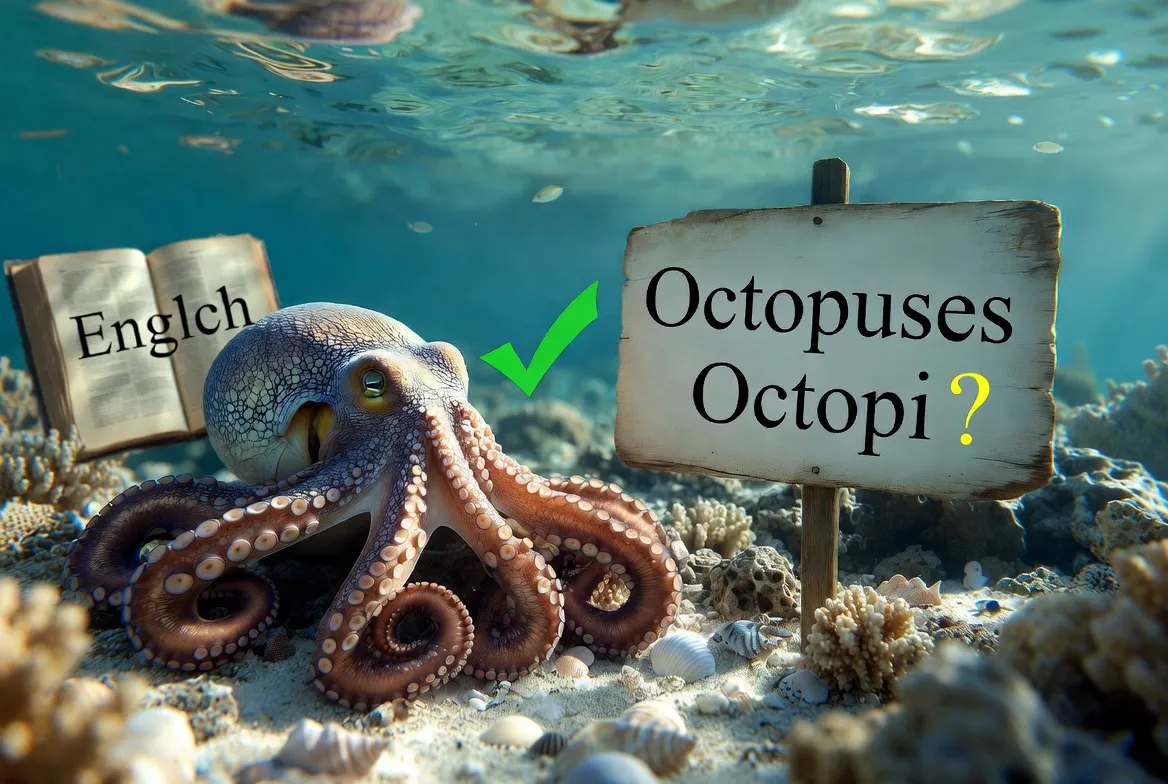
Octopi or octopuses are two plural forms of the word octopus. Octopuses is the standard and most widely accepted plural form, while octopi is a less common form based on a mistaken Latin ending.
Have you ever written a sentence about more than one octopus and suddenly wondered, “Should I write octopi or octopuses?” You are not alone. I have seen many students, writers, and even confident English speakers pause at this exact word.
I remember correcting a science article where the writer used “octopi” because it sounded more scientific. At first glance, it seemed right. After all, many English words ending in -us change to -i, like cactus/cacti or fungus/fungi. But the story of octopus is different.
This small spelling choice creates a lot of confusion because English borrows words from many languages. Some words keep their original endings, while others adapt to normal English rules.
In this guide, you will discover the real difference between octopi and octopuses, where these forms come from, which one you should use, and how to avoid common mistakes. By the end, you will feel confident choosing the correct plural form in everyday writing, school work, and professional communication.
Let’s uncover the truth behind this fascinating sea creature’s name.
Octopi or Octopuses – Quick Answer
The correct and most common plural form of octopus is octopuses.
Octopuses follows the normal English rule of adding -es to words ending in -us.
Examples:
- One octopus lives in the aquarium.
- Three octopuses are swimming near the rocks.
The word octopi is also seen in English, but many language experts consider it incorrect because it assumes that octopus comes from Latin.
Examples:
- ❌ The aquarium has five octopi.
- ✅ The aquarium has five octopuses.
For modern English writing, especially in schools, articles, and professional work, octopuses is the safest choice.
The Origin and Background of Octopus
To understand why people argue about octopi or octopuses, we need to look at where the word octopus comes from.
The word octopus comes from the Greek word oktṓpous, meaning “eight-footed.”
It combines:
- oktō = eight
- pous = foot
So, the name describes the animal’s eight arms.
The confusion began because the word ends with -us. Many English speakers connect this ending with Latin words.
For example:
| Singular Word | Traditional Plural |
| cactus | cacti |
| fungus | fungi |
| alumnus | alumni |
Because of these examples, people assumed:
- octopus → octopi
But there is a problem.
Octopus is not originally a Latin word. It is a Greek word.
The Greek plural form would be closer to octopodes, not octopi.
However, English has changed the word over time. Instead of keeping the original Greek form, most speakers naturally use the English plural octopuses.
This is a common pattern in English. Many borrowed words become easier and more natural over time.
Octopi or Octopuses Explained : Key Differences and Variations
Although both words appear in English, they are not used equally.
The main difference is based on origin, acceptance, and usage.
| Term | Meaning | When to Use | Region/Context |
| Octopus | One eight-armed sea animal | When talking about a single animal | Worldwide |
| Octopuses | More than one octopus | Best choice for general writing | Modern English |
| Octopi | A debated plural form of octopus | Rare or informal use | Some English speakers |
| Octopodes | Greek-based plural form | Academic or linguistic discussions | Specialized contexts |
Octopuses: The Recommended Choice
Most dictionaries recognize octopuses as the standard plural.
It is easy to understand and follows English grammar rules.
Examples:
- Marine scientists studied several octopuses.
- The aquarium introduced two new octopuses.
Octopi: Why People Use It
The word octopi sounds familiar because many English words use the Latin -i ending.
However, the ending is based on a misunderstanding of the word’s history.
Some people still use it because:
- It sounds educated or formal.
- They know similar words like cacti and radii.
- They learned it from older sources.
Still, in modern writing, octopuses is usually preferred.
Which Version Should You Use?
Choosing between octopi or octopuses depends on your audience and purpose.
For Students and Beginners
Use octopuses.
It is simple, correct, and accepted by teachers, editors, and most dictionaries.
Example:
The ocean contains many different species of octopuses.
For Professional Writing
Use octopuses.
Scientific articles, news reports, and educational materials usually prefer the standard English plural.
Example:
Researchers observed octopuses changing their skin color.
For Language or History Discussions
You may mention octopi or octopodes when discussing word origins.
Example:
The plural “octopi” became popular because people connected octopus with Latin words.
For Global English Use
The safest choice is always:
✅ Octopuses
It is understood everywhere and avoids unnecessary confusion.
Common Mistakes with Octopi or Octopuses
Even strong English writers sometimes make mistakes with octopi or octopuses because the word looks like many Latin-based nouns. Let’s look at the most common errors and how to fix them.
| Common Mistake | Correct Form | Why |
| The ocean has many octopi. | The ocean has many octopuses. | Octopuses is the standard English plural. |
| I saw three octopus at the aquarium. | I saw three octopuses at the aquarium. | Singular and plural forms must match. |
| The scientist studied several octopi species. | The scientist studied several octopus species or octopus species. | The word octopus can act as a noun modifier. |
| The aquarium displayed two octopodes. | The aquarium displayed two octopuses. | Octopodes is rare and mainly used in language discussions. |
| Octopi is the correct scientific term. | Octopuses is the common accepted term. | Scientific writing usually avoids unnecessary unusual forms. |
Why These Mistakes Happen
The main reason is the influence of other plural rules.
Many learners memorize patterns like:
- cactus → cacti
- focus → foci
- fungus → fungi
Then they apply the same rule:
- octopus → octopi
But English does not work only through patterns. Many words have unique histories.
The best approach is to learn the word as it is commonly used today.
Octopi or Octopuses in Real-World Examples
Seeing the word in real situations makes the difference easier to remember.
1. Professional Email Example
Correct usage:
Dear Dr. Smith,
The research team has completed observations of several octopuses in their natural habitat. The findings will be shared next week.
Why it works:
The word sounds natural and professional. It fits scientific communication.
2. News Article Example
Headline:
Scientists Discover How Octopuses Solve Complex Problems
Why it works:
News organizations usually choose familiar English forms. Readers immediately understand octopuses.
3. Social Media Example
Post:
Did you know that octopuses have three hearts and can change their skin color? Nature is amazing! 🐙
Why it works:
The word feels natural in everyday conversation.
4. Formal Report Example
Sentence:
This report examines how octopuses adapt to different ocean environments.
Why it works:
Formal writing values clarity. The standard plural avoids distracting the reader.
Octopi or Octopuses : Data, Trends & Usage
The search interest around octopi or octopuses shows an interesting language pattern.
People usually search this phrase when they are:
- Writing school assignments
- Creating educational content
- Checking grammar before publishing
- Learning English as a second language
- Comparing unusual plural forms
The search intent is mainly informational.
Readers are not usually looking to buy something. They want a clear answer about correctness.
Why This Question Matters Today
English learners often encounter confusing plural forms online. A quick search can reveal different answers, especially when older grammar rules mix with modern usage.
The lesson is simple:
The most historically accurate form is not always the most commonly accepted form.
For everyday English, octopuses wins because it is clear, natural, and widely understood.
Standalone Comparison Table: Octopi vs Octopuses
| Term/Variant | Meaning | Region/Context | Best Used When |
| Octopus | One eight-armed sea animal | All English varieties | Talking about one animal |
| Octopuses | More than one octopus | Modern global English | Everyday, academic, and professional writing |
| Octopi | A commonly used but debated plural | Informal or traditional usage | Discussing language history or casual speech |
| Octopodes | Greek-origin plural form | Linguistic or academic discussions | Talking about Greek word origins |
Frequently Asked Questions About Octopi or Octopuses
Q: What does octopi or octopuses mean?
A: Both words refer to more than one octopus. However, octopuses is the standard plural form used in modern English. Octopi is a less common form based on the incorrect idea that octopus comes from Latin.
Q: How do you use octopuses correctly?
A: Use octopuses whenever you are talking about two or more of these sea animals. For example: “The aquarium has five octopuses.” It works in casual, academic, and professional writing.
Q: Octopi vs octopuses : what is the difference?
A: The difference is mainly about acceptance and history. Octopuses follows English grammar rules, while octopi comes from applying a Latin-style plural ending to a Greek word.
Q: Is octopi acceptable in formal writing?
A: Some dictionaries recognize octopi, but it is usually avoided in formal writing because many readers consider it incorrect or outdated. Octopuses is the safer choice.
Q: Which version is correct : octopi or octopuses?
A: Both forms appear in English, but octopuses is considered the correct and preferred plural form today. It is the best option for most situations.
Q: Where does the word octopus come from?
A: The word octopus comes from Greek. It comes from oktōpous, meaning “eight-footed,” referring to the animal’s eight arms.
Q: Can octopuses be used in scientific writing?
A: Yes. Octopuses is commonly used in scientific writing, research papers, and educational materials. Scientists generally prefer clear and accepted English forms.
Conclusion
The debate between octopi or octopuses shows how interesting English can be. A single word can carry a history of different languages, changing rules, and common misunderstandings.
The main points to remember are simple:
- Octopus means one sea animal with eight arms.
- Octopuses is the preferred plural form in modern English.
- Octopi exists, but it comes from a mistaken Latin-style pattern.
- Clear communication matters more than using a complicated-looking word.
When you write an article, assignment, email, or report, choose octopuses. It sounds natural, professional, and correct to most readers.
English has many unusual words, but learning their real stories makes them easier to remember.
Now you know exactly how to use octopi or octopuses : bookmark this guide so you never second-guess this word again.
Intel or AMD: Complete Guide to Choosing the Best CPU

Taha Husnain is an English researcher specializing in literature, language studies, and critical analysis. Their work focuses on advancing scholarly understanding through research and academic writing, with contributions to contemporary discussions in English studies.