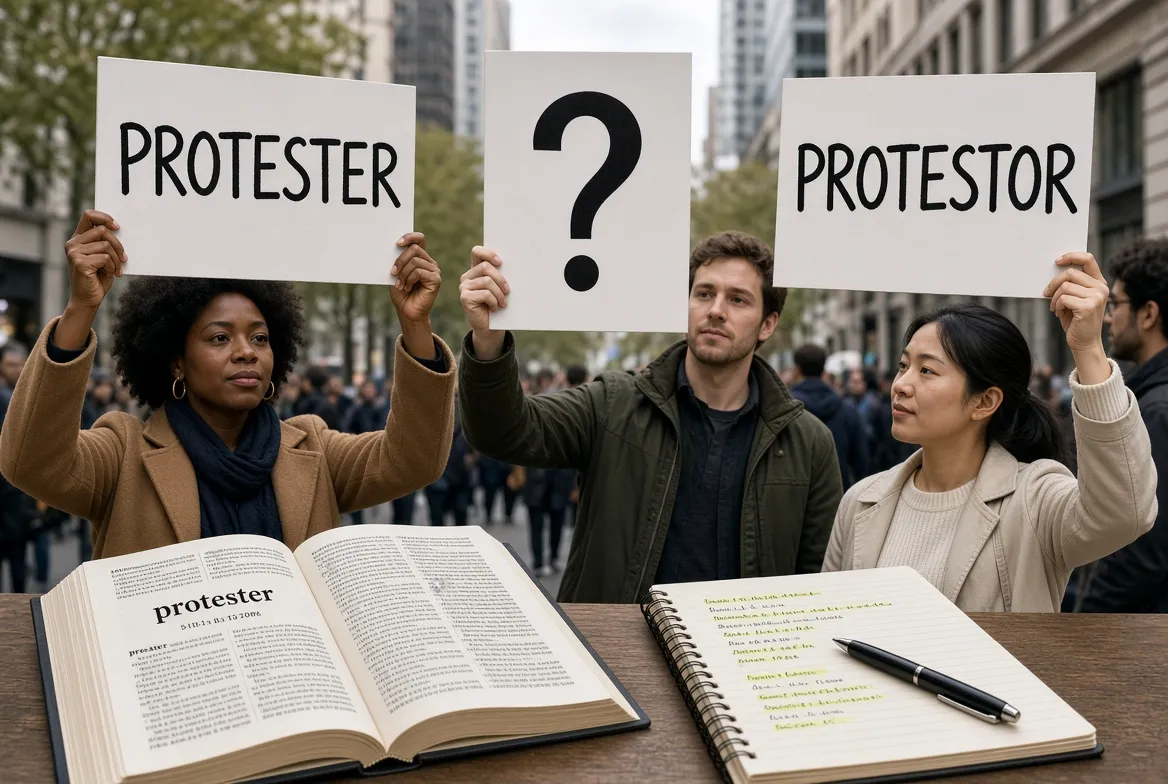
Both “protestor” and “protester” are correct. They mean the same thing: a person who takes part in a protest.
- Protester : the more common spelling.
- Protestor : also correct, but less common.
Best choice: Use protester in most everyday, academic, professional, and SEO writing.
Example: Thousands of protesters gathered outside the government building.
When you see the words protestor or protester, you may wonder which spelling is correct. Both forms appear in English, especially in news articles, books, and online discussions. The good news is that both “protestor” and “protester” are correct spellings. They have the same basic meaning: a person who takes part in a protest.
The main difference is not meaning but usage and regional preference. “Protester” is the more common form in modern English, while “protestor” is also accepted and appears in some dictionaries and formal contexts.
This small spelling difference can be confusing for students, writers, bloggers, and non-native English speakers. If you are writing an email, school assignment, news article, or website content, you may want to know which form sounds most natural.
In this guide, we will explain the meaning, origin, spelling, regional usage, and everyday examples of both forms. You will also learn which spelling is usually the safest choice for your audience.
Protestor or Protester – Quick Answer
Both “protestor” and “protester” are correct. They describe a person who takes part in a protest or publicly expresses disagreement with something.
However, “protester” is generally more common in modern English, especially in everyday writing and news reporting.
Examples:
- The protester held a sign outside the building.
- Several protesters gathered in the city center.
- The newspaper interviewed a protestor after the demonstration.
Both spellings can refer to the same person. The choice usually depends on style, region, and personal preference.
If you are unsure which form to use, protester is usually the best choice because it is widely recognized and commonly used.
The Origin of Protestor or Protester
Both words come from the verb protest, which means to express strong disagreement or opposition.
The word “protest” comes from Latin protestari, meaning “to declare publicly” or “to testify.” Over time, it developed into the English word we use today for a public expression of disagreement.
The suffix -er is commonly used in English to describe a person who performs an action. For example:
- teach → teacher
- write → writer
- work → worker
- protest → protester
The ending -or is also used in English to form nouns for people who perform an action. This helps explain why protestor developed alongside protester.
The two forms have therefore existed in English without a major difference in meaning. Language usage has simply favored protester in many modern contexts.
British English vs American English Spelling
Unlike some spelling differences between British and American English, this is not a strict UK-versus-US spelling rule. Both forms can be found in different English-speaking regions.
| Version | Spelling | Region | Example Sentence |
|---|---|---|---|
| Common form | protester | US, UK, and international English | The protester spoke to reporters. |
| Alternative form | protestor | US, UK, and other English varieties | The protestor joined the demonstration. |
“Protester” is usually the more familiar choice for general readers. “Protestor” is still grammatically valid and may appear in formal writing, journalism, and legal or political contexts.
So, unlike words such as color/colour or center/centre, you do not need to change the spelling simply because your audience is British or American.
Which Spelling Should You Use?
US audience
For American readers, protester is a safe and natural choice. “Protestor” is also correct, but “protester” is generally more familiar.
UK and Commonwealth audience
For British and Commonwealth readers, protester is also a strong choice. “Protestor” is not necessarily wrong, but it is less likely to be the preferred everyday form.
Global and SEO audience
If you are writing for a global audience, protester is usually the best option. It is simple, widely understood, and common in news and general writing.
For SEO, you do not need to repeat both spellings throughout an article. Use the more common form naturally and mention the alternative once or twice when explaining the spelling difference.
Common Mistakes with Protestor or Protester
Here are some common mistakes to avoid:
| Incorrect | Correct |
|---|---|
| The protester protested against the law. | The protester protested against the law. |
| Many protestors was outside. | Many protesters were outside. |
| He is a protester who joined the march. | He is a protester who joined the march. |
| The protester’s demanded change. | The protesters demanded change. |
The biggest grammar mistake is often not the spelling. It is subject-verb agreement.
For example:
- ❌ The protesters was angry.
- ✅ The protesters were angry.
Remember that protester and protestor are singular nouns. Their plural forms are protesters and protestors.
Protestor or Protester in Everyday Examples
Both forms can appear in different types of writing.
Emails
The protester was asked to leave the private property.
News headlines
Protesters Gather Outside City Hall
Social media
Hundreds of protesters joined today’s peaceful march.
Formal writing
The report examined the rights of protesters during public demonstrations.
In most everyday situations, protester sounds natural and familiar. You may still see “protestor” in newspapers, academic writing, legal documents, or other formal sources.
The important point is that neither spelling automatically changes the meaning.
Protestor or Protester – Google Trends & Usage
Search interest for these spellings can vary by country, topic, and time. “Protester” generally has broader everyday usage, so it is more likely to appear in common searches, news reports, and general online content.
“Protestor” is also used, but it tends to be less common. It may appear more often in certain formal, legal, political, or journalistic contexts.
Search behavior can also change during major demonstrations or political events. When protests receive widespread news coverage, searches for both spellings may increase.
For writers targeting a broad international audience, protester is usually the clearest choice. It is familiar to readers across different English-speaking regions and works well in general content.
Protester vs Protestor: Side-by-Side Comparison
| Feature | Protester | Protestor |
|---|---|---|
| Correct spelling | Yes | Yes |
| Meaning | Person who protests | Person who protests |
| Part of speech | Noun | Noun |
| Commonness | More common | Less common |
| Plural | Protesters | Protestors |
| Used in US English | Yes | Yes |
| Used in British English | Yes | Yes |
| Best for general readers | Yes | Acceptable |
The two words have essentially the same meaning. The main difference is frequency and preference, not correctness.
FAQs About Protestor or Protester
Is protester or protestor correct?
Both protester and protestor are correct. “Protester” is generally the more common form.
Is protestor a real word?
Yes. Protestor is a valid English word for someone who takes part in a protest.
Is protester more common than protestor?
Yes. Protester is generally more common in modern everyday English, news writing, and online content.
Do protester and protestor mean the same thing?
Yes. Both words describe a person who protests or takes part in a protest.
Which spelling should I use in American English?
Protester is usually the safest choice for American readers, although “protestor” is also accepted.
Which spelling is better for SEO?
For broad SEO content, protester is usually the better primary form because it is more widely used. You can mention “protestor” as an alternative spelling.
What is the plural of protester?
The plural is protesters. The plural of “protestor” is protestors.
Conclusion
So, protestor or protester? The answer is simple: both spellings are correct. They have the same basic meaning and refer to a person who takes part in a protest or expresses public disagreement.
The main difference is usage. Protester is the more common and familiar form in modern English. It appears frequently in everyday writing, news reports, online articles, and general conversation. Protestor is also accepted, but it is less common.
You do not need to treat this as a strict British-versus-American spelling difference. Both forms can be found in British and American English.
If you are writing for students, general readers, or an international audience, protester is usually the best choice. It is clear, natural, and widely recognized.
Most importantly, do not worry if you see “protestor” in a reliable source. It is not automatically a spelling error. Both forms are valid; protester is simply the more common choice.
Pleasure or Pain: Meaning, Differences, and How to Use

Smama Aroosh is an English author and scholar with a strong interest in literature, language, and contemporary writing. Their work reflects a commitment to academic excellence and thoughtful exploration of literary themes, contributing meaningfully to the field of English studies.