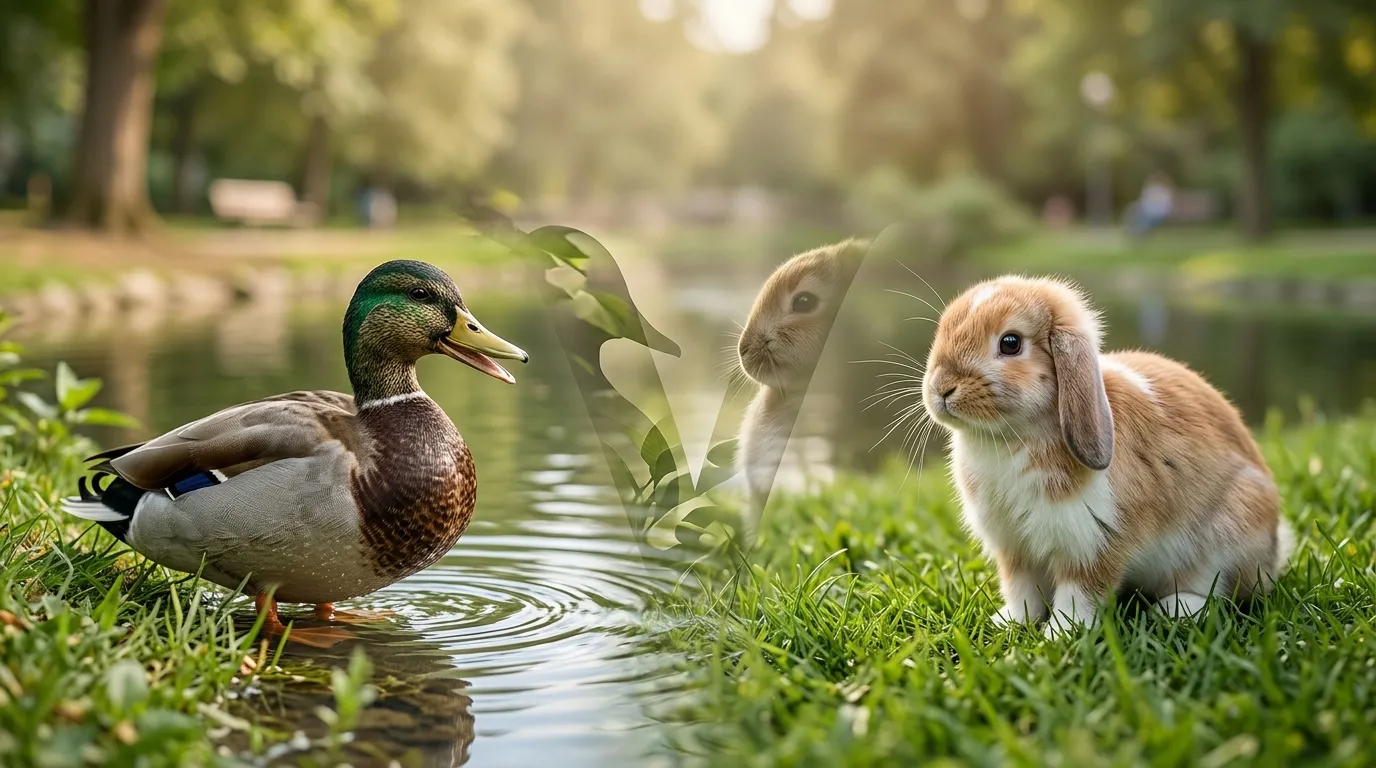
Duck and rabbit are both correct words, but they name different animals.
Use duck for the bird and rabbit for the small mammal.
Have you ever looked at a picture and wondered, “Is that a duck or rabbit?” You are not alone. The phrase duck or rabbit often appears when people talk about an optical illusion, animal identification, or a famous image that can look like either animal. It can also confuse English learners who wonder whether “duck” and “rabbit” are different spellings, forms, or words for the same thing.
The good news is simple: duck and rabbit are both correct English words. They name two different animals. A duck is a water bird, while a rabbit is a small mammal with long ears and strong back legs.
The phrase duck or rabbit is often used when something can be seen in two different ways. It became especially well known through the famous duck-rabbit illusion, where the same drawing can look like a duck or a rabbit.
In this guide, we will explain the meaning, origin, spelling, usage, common mistakes, and everyday examples of duck or rabbit in simple English.
Duck or Rabbit – Quick Answer
Duck and rabbit are both correct words. They are not different spellings of the same word.
- Duck = a bird that often lives near water.
- Rabbit = a small mammal with long ears.
- Duck or rabbit = a phrase often used for an image or object that can look like either animal.
Simple examples
- “Is the picture a duck or rabbit?”
- “I can see a duck, but my friend sees a rabbit.”
- “The artist created a duck or rabbit optical illusion.”
So, there is no spelling choice between the two. Your choice depends on what you mean.
The Origin of Duck or Rabbit
The words duck and rabbit have different histories.
The word duck has old Germanic roots. Its modern English form developed from earlier words connected with the bird and with the idea of bending or dipping. Ducks are water birds commonly found around ponds, lakes, and rivers.
The word rabbit came into English through French. It became common in English during the Middle Ages and refers to the small animal known for its long ears, soft fur, and ability to hop.
The phrase duck or rabbit became especially interesting because of the famous duck-rabbit illusion. The drawing can be viewed as either a duck or a rabbit depending on how the viewer interprets its shape.
This is not a spelling difference. It is a difference in meaning and visual interpretation.
British English vs American English Spelling
There is no British-American spelling difference for these two words.
Both British English and American English use:
- duck
- rabbit
The spelling stays the same in both varieties of English.
| Version | Spelling | Region | Example Sentence |
|---|---|---|---|
| British English | duck | UK/Commonwealth | “The duck is swimming in the pond.” |
| American English | duck | US | “The duck is swimming in the pond.” |
| British English | rabbit | UK/Commonwealth | “The rabbit is eating grass.” |
| American English | rabbit | US | “The rabbit is eating grass.” |
If you see duck or rabbit, you do not need to change the spelling for British or American readers.
Which Spelling Should You Use?
Your choice should depend on the meaning, not the country.
US audience
Use duck when you mean the bird. Use rabbit when you mean the small mammal.
For example:
“The rabbit ran across the garden.”
UK/Commonwealth audience
The same spellings are correct:
“A duck was swimming in the pond.”
There is no British spelling such as “dduck” or “rabitt.”
Global/SEO audience
For a global audience, use the standard spellings duck and rabbit.
If your article discusses the famous visual illusion, phrases such as duck or rabbit illusion, duck-rabbit illusion, and duck or rabbit picture can help readers understand the topic.
The key point is simple: do not treat duck and rabbit as spelling alternatives. They are two different animal names.
Common Mistakes with Duck or Rabbit
English learners may make a few simple mistakes with these words.
| Incorrect | Correct | Why? |
|---|---|---|
| rabit | rabbit | The correct spelling has two “b” letters. |
| ducck | duck | The correct spelling ends with “ck.” |
| duck and rabbit is the same animal | duck and rabbit are different animals | They are different animals. |
| I saw a rabbit swimming like a duck. | I saw a rabbit swimming like a duck. | This sentence is correct if it describes the action. |
| Is this duck rabbit? | Is this a duck or a rabbit? | Use “or” when choosing between two possibilities. |
Another common mistake is using duck or rabbit when you actually mean only one animal.
For example:
- “I saw a duck in the lake.” ✓
- “I saw a rabbit in the garden.” ✓
- “Is this a duck or rabbit?” ✓ when the answer is uncertain.
Duck or Rabbit in Everyday Examples
The phrase can appear in many types of writing.
Emails
“Could you tell me if the picture shows a duck or rabbit?”
News headlines
“Famous Duck-Rabbit Illusion Makes Viewers See Two Animals”
Social media
“What do you see first: a duck or rabbit?”
Formal writing
“The illustration can be interpreted as either a duck or a rabbit.”
The phrase is especially useful when discussing optical illusions, perception, drawings, puzzles, and visual tests.
Duck or Rabbit – Google Trends & Usage
Search interest for duck and rabbit can vary depending on location and context. Both are common English animal words, so people may search for them for many reasons.
Searches for duck may relate to animals, food, sports, children’s books, or phrases such as “sitting duck.”
Searches for rabbit may relate to pets, wildlife, stories, cartoons, or phrases such as “rabbit hole.”
The combined phrase duck or rabbit is more closely connected to visual puzzles and the famous duck-rabbit illusion. Interest can increase when the image appears on social media, in psychology discussions, educational content, or online quizzes.
For SEO, it is best to use the phrase naturally and explain the user’s likely question instead of repeating it too often.
Duck vs Rabbit: Comparison at a Glance
| Feature | Duck | Rabbit |
|---|---|---|
| Type of animal | Bird | Mammal |
| Main feature | Feathers and bill | Fur and long ears |
| Movement | Walks, swims, flies | Hops and runs |
| Common habitat | Ponds, lakes, wetlands | Fields, gardens, forests |
| Standard spelling | Duck | Rabbit |
| British spelling | Duck | Rabbit |
| American spelling | Duck | Rabbit |
| Can appear in an optical illusion? | Yes | Yes |
FAQs About Duck or Rabbit
Is duck or rabbit a spelling choice?
No. Duck and rabbit are two different words with different meanings. They are not alternative spellings.
Which is correct, duck or rabbit?
Both are correct. Use duck for the bird and rabbit for the small mammal.
Is rabbit spelled with one or two Bs?
The correct spelling is rabbit, with two “b” letters.
Is duck spelled differently in British English?
No. Duck has the same spelling in British and American English.
What does duck or rabbit mean?
It can simply mean choosing between a duck and a rabbit. It can also refer to an image that can be interpreted as either animal.
What is the duck-rabbit illusion?
It is a famous ambiguous image that can be seen as either a duck or a rabbit, depending on how you look at it.
Is “duck or rabbit” grammatically correct?
Yes. The phrase is grammatically correct when you are asking someone to choose between the two possibilities.
Conclusion
Duck or rabbit is not a question about two spellings of the same word. Duck and rabbit are both correct English words, but they describe different animals.
A duck is a bird, often found near water. A rabbit is a small mammal with long ears and strong back legs. Both words have the same spelling in British and American English, so you do not need to choose a regional spelling.
The phrase duck or rabbit is especially common when talking about an optical illusion. The famous duck-rabbit image can look like either animal, depending on how the viewer sees it.
If you are writing for a US, UK, or global audience, simply use the word that matches your meaning. Use duck for the bird and rabbit for the mammal. When discussing an ambiguous picture, duck or rabbit is the natural phrase.
Once you understand the difference, there is no need to worry about the spelling. Both words are correct; the context tells you which one to use.
That or Which: Difference and When Should You Use Each?

Smama Aroosh is an English author and scholar with a strong interest in literature, language, and contemporary writing. Their work reflects a commitment to academic excellence and thoughtful exploration of literary themes, contributing meaningfully to the field of English studies.