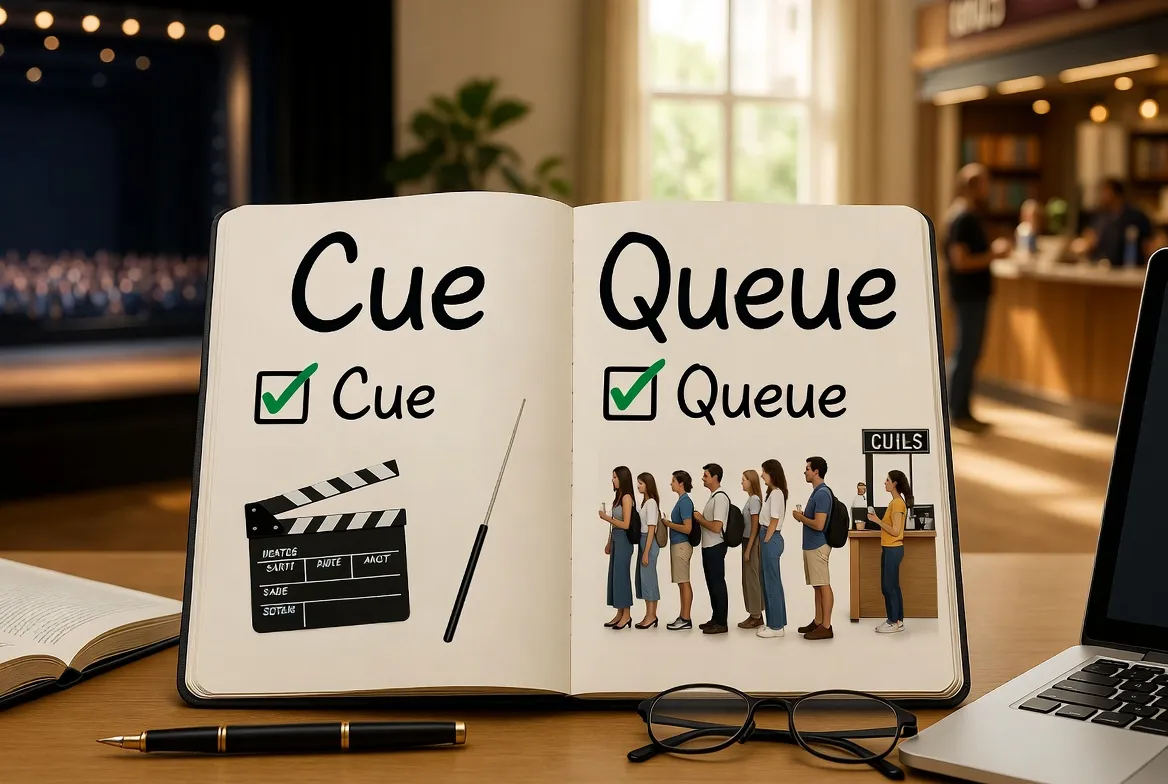
Cue or queue are two different words with different meanings. Cue means a signal, hint, or prompt, while queue means a line of people or things waiting for a turn.
Have you ever typed a word and suddenly wondered, “Is this the right spelling?” I have seen this happen many times while helping students improve their English writing. One of the most common mix-ups I notice is between cue and queue.
At first glance, these words look almost the same. They even sound alike. But their meanings are completely different. A person waiting in a line may write “I am standing in the cue,” while someone giving a signal may write “I gave him a queue.” Both sentences are wrong.
This small spelling mistake can change the entire meaning of a sentence. That is why many learners search for cue or queue when writing emails, essays, reports, or social media posts.
In this guide, I will explain the difference between these two words in a simple way. You will learn their meanings, origins, correct usage, common mistakes, and real-life examples. By the end, you will never confuse cue or queue again.
Cue or Queue – Quick Answer
Cue and queue sound identical, but they are used in different situations.
- Cue = a signal, sign, hint, or instruction that tells someone what to do.
- Queue = a line of people, vehicles, or objects waiting for something.
Simple Examples:
Cue:
- The actor waited for his cue before entering the stage.
- The teacher gave students a cue to start writing.
Queue:
- We stood in a queue outside the cinema.
- There was a long queue at the bank.
A simple trick:
Cue = Clue
Both give a hint.
Queue = Line
Both describe waiting.
The Origin / Background of Cue or Queue
The confusion between cue or queue exists because both words have similar pronunciation but different histories.
The word cue comes from the French word queue, meaning “tail.” Over time, English speakers began using cue as a shortened form of “queue” in theatre and music.
In the world of acting, a cue became a signal that tells performers when to speak, move, or begin an action.
Example:
- The actor waited for his cue to enter the scene.
The word queue also came from French and originally meant a “tail.” It was used to describe a line that looked like a tail.
Over time, English adopted queue to describe a waiting line.
Example:
- People formed a queue outside the store.
Although these words share a historical connection, modern English treats them as separate words with separate meanings.
Cue or Queue Explained : Key Differences and Uses
Understanding the difference between cue or queue becomes easy when you focus on the situation.
| Term | Meaning | When to Use | Region/Context |
| Cue | A signal, hint, or prompt | When someone receives an instruction or sign | Theatre, conversation, sports, communication |
| Queue | A line of waiting people or things | When people or objects wait in order | British English, public places, technology |
Cue: A Signal or Reminder
A cue tells someone that something should happen.
Common uses include:
- Acting and performances
- Music
- Sports
- Teaching
- Communication
Examples:
- The director gave the actor a cue.
- The whistle was the cue for the players to begin.
- Her smile was a cue that she was happy.
A cue can be:
- Spoken
- Written
- Visual
- Physical
Queue: A Waiting Line
A queue describes people or things arranged in order.
Examples:
- Customers waited in a long queue.
- The printer has five documents in the queue.
- Cars formed a queue near the traffic signal.
The word is especially common in British English.
American English speakers often use the word line instead.
Example:
British English:
- I am waiting in the queue.
American English:
- I am waiting in the line.
Which Version Should You Use?
Choosing between cue or queue depends on what you want to say.
For Students and English Learners
Use cue when talking about:
- Signals
- Instructions
- Hints
- Actions
Example:
- The teacher gave a cue to answer the question.
Use queue when describing:
- Waiting lines
- Order systems
- Online waiting lists
Example:
- My name is in the customer service queue.
For Professional Writing
Both words are correct, but accuracy matters.
Use cue in:
- Presentations
- Scripts
- Training materials
- Communication guides
Example:
- The presenter used a visual cue to explain the idea.
Use queue in:
- Business systems
- Customer service reports
- Technical documents
Example:
- The support team is handling requests in the queue.
For Global English Use
If your audience is international, choose the word that matches the meaning clearly.
Remember:
- A cue helps someone know what to do.
- A queue is something people wait in.
Common Mistakes with Cue or Queue
Many learners confuse these words because they sound identical. Here are common errors.
| Mistake | Correction | Why It Is Wrong |
| I waited in the cue. | I waited in the queue. | A waiting line is a queue. |
| The actor missed his queue. | The actor missed his cue. | A performance signal is a cue. |
| She gave me a queue to start. | She gave me a cue to start. | A signal is a cue. |
| The customer service cue is long. | The customer service queue is long. | A waiting system is a queue. |
Why Do These Mistakes Happen?
The main reason is pronunciation.
Both words sound like:
“kyoo”
English has many words called homophones. These words sound the same but have different meanings.
Examples:
- Two / Too
- There / Their
- Write / Right
- Cue / Queue
Learning the meaning behind each word helps prevent spelling mistakes.
Cue or Queue in Real-World Examples
1. Professional Email
Cue Example:
Please use the presentation slide change as your cue to begin speaking.
Meaning: The slide gives a signal.
Queue Example:
Your request has been added to the support queue.
Meaning: The request is waiting for attention.
2. News Headline
Cue Example:
New Study Offers a Cue for Better Health Decisions
Meaning: A hint or indication.
Queue Example:
Long Queues Form Outside Stores During Holiday Sales
Meaning: Waiting lines appear.
3. Social Media Post
Cue Example:
That song was my cue to start dancing!
Meaning: The song gave a signal.
Queue Example:
Waiting in a coffee shop queue for 20 minutes!
Meaning: Standing in line.
4. Formal Report
Cue Example:
The warning light acts as a cue for immediate action.
Queue Example:
The system places new requests into a digital queue.
Cue or Queue : Data, Trends & Usage
The search term “cue or queue” is mainly informational. People usually search it when they are learning English, correcting writing mistakes, or preparing for exams.
This confusion is common among:
- English language learners
- Students
- Writers
- Professionals who use English daily
The reason this topic remains popular is simple: English contains many homophones that create spelling challenges.
In digital communication, correct word choice matters more than ever. A small spelling mistake in an email, report, or article can affect clarity and professionalism.
Understanding words like cue or queue helps writers build stronger vocabulary and communicate with confidence.
Cue or Queue: Complete Comparison Table
| Term/Variant | Meaning | Region/Context | Best Used When |
| Cue | Signal, hint, or prompt | Global English | You need to describe a sign or instruction |
| Queue | Waiting line or sequence | Common in British English and technology | You describe people, vehicles, or tasks waiting in order |
Frequently Asked Questions About Cue or Queue
Q: What does cue mean?
A: Cue means a signal, hint, or action that tells someone what to do next. It is often used in theatre, communication, sports, and everyday situations.
Q: What does queue mean?
A: Queue means a line of people, vehicles, or items waiting for their turn. It can also describe a list of tasks waiting to be processed.
Q: What is the difference between cue and queue?
A: A cue is a signal or reminder, while a queue is a waiting line. They sound the same but have different meanings.
Q: Is cue or queue correct in formal writing?
A: Both are correct when used properly. The correct choice depends on the meaning of your sentence.
Q: Which spelling is correct : cue or queue?
A: Both spellings are correct. Use cue for signals and queue for waiting lines.
Q: Where does the word queue come from?
A: The word queue comes from French and originally meant “tail.” It later became a word for a line because people standing together looked like a tail.
Q: Can queue be used in technology?
A: Yes. In technology, a queue refers to a list of tasks waiting to be processed, such as printer jobs or computer requests.
Conclusion
The difference between cue or queue is simple once you understand their purpose.
A cue gives a signal. It tells someone when or how to act. A queue is a line where people or things wait in order.
Remember these easy tips:
- Cue = Clue = Signal
- Queue = Line = Waiting
Both words sound the same, but their meanings are completely different. Using the right word makes your writing clearer and more professional.
Whether you are writing an email, preparing an essay, or improving your English skills, knowing small differences like this can make a big impact.
Now you know exactly how to use cue or queue : try using these words correctly in your next piece of writing and share this guide with someone who often gets confused.
Octopi or Octopuses: The Complete Guide

Taha Husnain is an English researcher specializing in literature, language studies, and critical analysis. Their work focuses on advancing scholarly understanding through research and academic writing, with contributions to contemporary discussions in English studies.