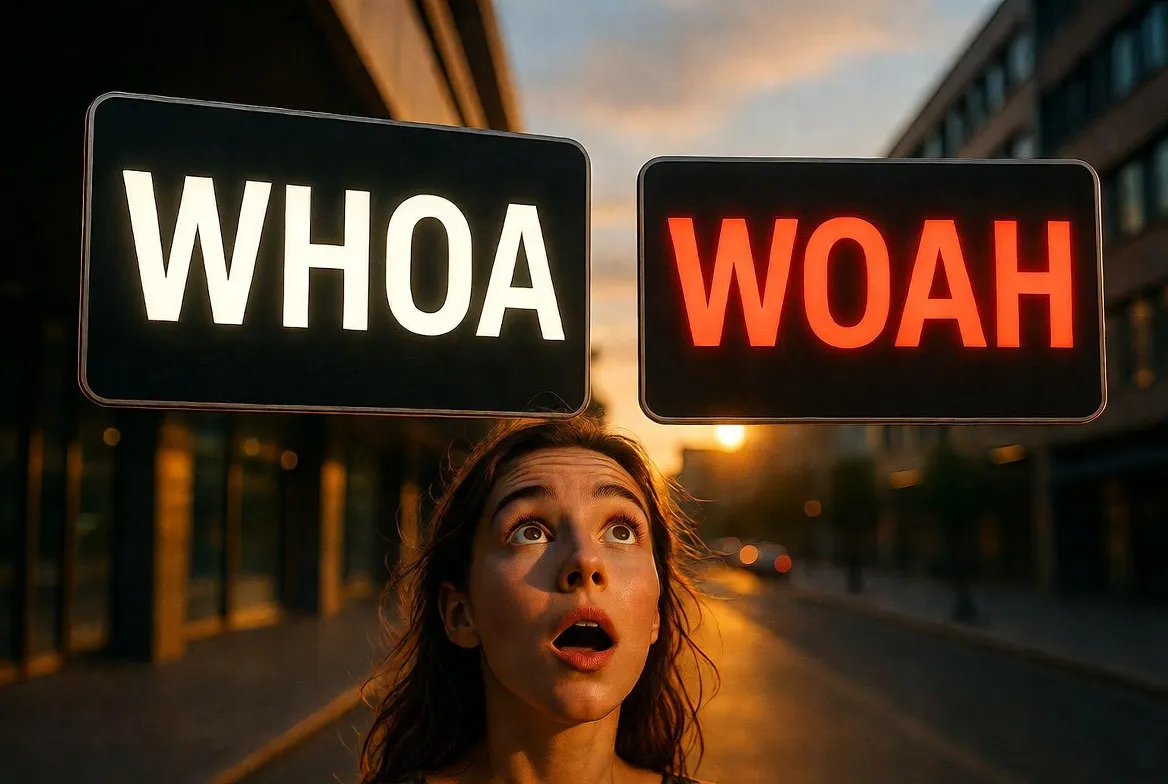
Whoa means “stop,” “slow down,” or expresses surprise and amazement, like “Whoa, that’s incredible!” It is the standard, correct spelling. Woah is a common informal variant or alternate spelling used mostly online and in casual writing.
I remember the first time I saw “woah” in a student’s essay. As an English teacher with over a decade of experience helping writers of all ages, I paused. Was it a typo? A new trend? Or had I missed something? That moment sent me digging into the word’s history, and it opened my eyes to how language evolves right under our noses.
You’ve probably typed “whoa” or “woah” a hundred times when something catches you off guard : a plot twist in a movie, a wild sports play, or a friend sharing big news. But which one is right? And does it even matter? This confusion pops up all the time because both spellings sound exactly the same, and the internet loves mixing them up.
In this guide, I’ll walk you through everything you need to know. You’ll learn the real meanings, where each spelling comes from, when to pick one over the other, and how to avoid mistakes that make your writing look sloppy. By the end, you’ll feel confident using this word in texts, emails, social posts, or school papers. Let’s clear this up once and for all.
Whoa – Quick Answer
Whoa is an interjection. You use it to tell someone (or a horse) to stop or slow down. It also shows surprise, shock, or that something impresses you. Think of it as a quick way to say “Hold up!” or “That’s amazing!”
Real-world examples:
- You see a friend about to step into traffic: “Whoa, watch out!”
- Your favorite team scores an unbelievable goal: “Whoa, did you see that?!”
It works great in casual chats and storytelling. People understand it instantly.
The Origin / Background of Whoa
“Whoa” has deep roots. It started as a variant of “ho” or “who,” an old call for attention from the 1400s or earlier. By the 1800s, it became the go-to command for stopping horses. Imagine a farmer yelling “Whoa!” to calm a team pulling a wagon.
Over time, it moved beyond horses. By the late 1800s and especially in the 20th century, people used it for surprise or to pause a conversation. The internet and memes gave it new life in the 1980s and beyond. “Woah” popped up as a phonetic spelling : people wrote it how they heard it.
The confusion exists because English spelling often follows sound, not strict rules, especially for exclamations. Dictionaries mostly stick with whoa as standard, but woah shows up more in casual British and Australian English.
Whoa Explained : Key Differences or Variations
Both spellings mean the same thing and sound identical. The main difference is formality and acceptance.
Whoa feels classic and reliable. Most style guides and American English prefer it.
Woah looks more modern or playful. It appears often in texts, tweets, and memes. Some see it as a creative variant; others call it a misspelling.
Here’s a clear comparison:
| Term | Meaning | When to Use | Region/Context |
| Whoa | Stop/slow down; express surprise | Formal, professional, general | Standard in US, books, school |
| Woah | Same as whoa | Casual texts, social media | More common in UK/Australia, informal |
Examples:
- “Whoa, that’s a huge spider!” (Standard and safe.)
- “Woah, that movie ending tho!” (Casual online chat.)
Which Version Should You Use?
For students and beginners: Stick with whoa. It looks polished and avoids questions from teachers or editors.
For friends and social media: Either works, but woah can feel fun and trendy in quick posts.
For global or neutral use: Go with whoa. It travels better and matches what most dictionaries recommend. In professional emails or reports, whoa keeps things clean.
My rule of thumb after years of teaching? When in doubt, choose whoa. It never hurts to be clear and standard.
Common Mistakes with Whoa or Woah
Here are the top slip-ups I see:
- Mixing them randomly : Mistake: “Woah, whoa, slow down!” Correction: Pick one spelling per piece for consistency.
- Using it in very formal writing : Mistake: “Whoa, the data shows…” in a business report. Correction: Use “Wait” or “Hold on” instead. Save interjections for casual spots.
- Confusing with “wow” : Mistake: Using “whoa” when pure excitement fits “wow” better. Correction: “Wow, that’s beautiful!” for joy; “Whoa!” for surprise that stops you.
- Overusing it : It loses punch if every other sentence has it.
- Forgetting punctuation : Mistake: “whoa thats crazy” Correction: “Whoa! That’s crazy.”
These errors happen because we type fast and rely on autocorrect. Slow down and double-check.
Whoa in Real-World Examples
Professional email:
“Team, whoa : the numbers from Q2 look promising. Let’s discuss next steps.”
News headline style:
“Whoa: Local Student Invents Device That Changes Everything!”
Social media post:
“Just tried the new rollercoaster. Woah! My heart is still racing. 🎢 #Adrenaline”
Formal document or report (rare, but possible in quotes):
“The witness stated, ‘Whoa, I couldn’t believe what I saw.'”
See how whoa fits most situations smoothly?
Whoa :Data, Trends & Usage
People search for “whoa or woah” because casual online writing blurs lines between standard and phonetic spellings. Searches spike around viral memes, sports events, and pop culture moments.
Whoa dominates in published books and formal content. Woah gains traction in user-generated spaces like TikTok, Reddit, and texting, especially among younger users.
This matters now because clear writing helps you stand out online and in school or work. In our fast-paced world, knowing small details like this builds confidence and credibility.
Standalone Comparison Table
| Term/Variant | Meaning | Region/Context | Best Used When |
| Whoa | Stop, surprise, amazement | Global standard, US English | Writing for school, work, clarity |
| Woah | Same meaning | Informal, UK/Aus online | Texts, memes, casual chats |
FAQ Section
Q: What does whoa mean?
A: Whoa means to stop or slow down, or it shows you feel surprised or impressed. It started with horses but now works for anything that makes you pause.
Q: How do you use whoa correctly?
A: Use it as an exclamation: “Whoa! Slow down.” Keep it casual. Pair it with an exclamation point for energy. Choose whoa in most writing.
Q: Whoa vs woah : what’s the difference?
A: Almost none in meaning. Whoa is the standard spelling. Woah is an informal variant. Most experts recommend whoa.
Q: Is woah acceptable in formal writing?
A: Usually not. Stick to whoa or rephrase entirely in academic or professional work. Woah shines in friendly messages.
Q: Which version is correct : whoa or woah?
A: Whoa is correct and preferred. Woah is widely understood but considered nonstandard by many dictionaries.
Q: Where does whoa come from?
A: It evolved from old calls like “ho” in the 1400s-1800s, first for stopping horses, then for general surprise.
Q: Can whoa be used in social media?
A: Absolutely! Both spellings work there. Woah often feels more playful in posts and comments.
Conclusion
You’ve now got the full picture: whoa is the reliable go-to spelling with centuries of history, while woah adds a casual, modern twist popular online. Key takeaways? Know your audience, favor whoa for most situations, and use it to add emotion without overdoing it. Small choices like this make your writing stronger and more engaging.
I recommend whoa as your default. It keeps things professional yet lively. Now you know exactly how to use it : go try it in your next text, post, or story. You might just surprise yourself with how natural it feels.
Bookmark this guide so you never second-guess yourself again. And share it with a friend who’s been confused about whoa or woah. Clear communication opens doors : keep practicing!
Loose or Lose: The Complete Easy Guide

Ifrah Maqsood is an English author passionate about creating articles that inspire and engage users.
Their work explores imagination, emotion, and the human experience across diverse themes.
Through their writing, they aim to leave a lasting impact on audiences around the world.