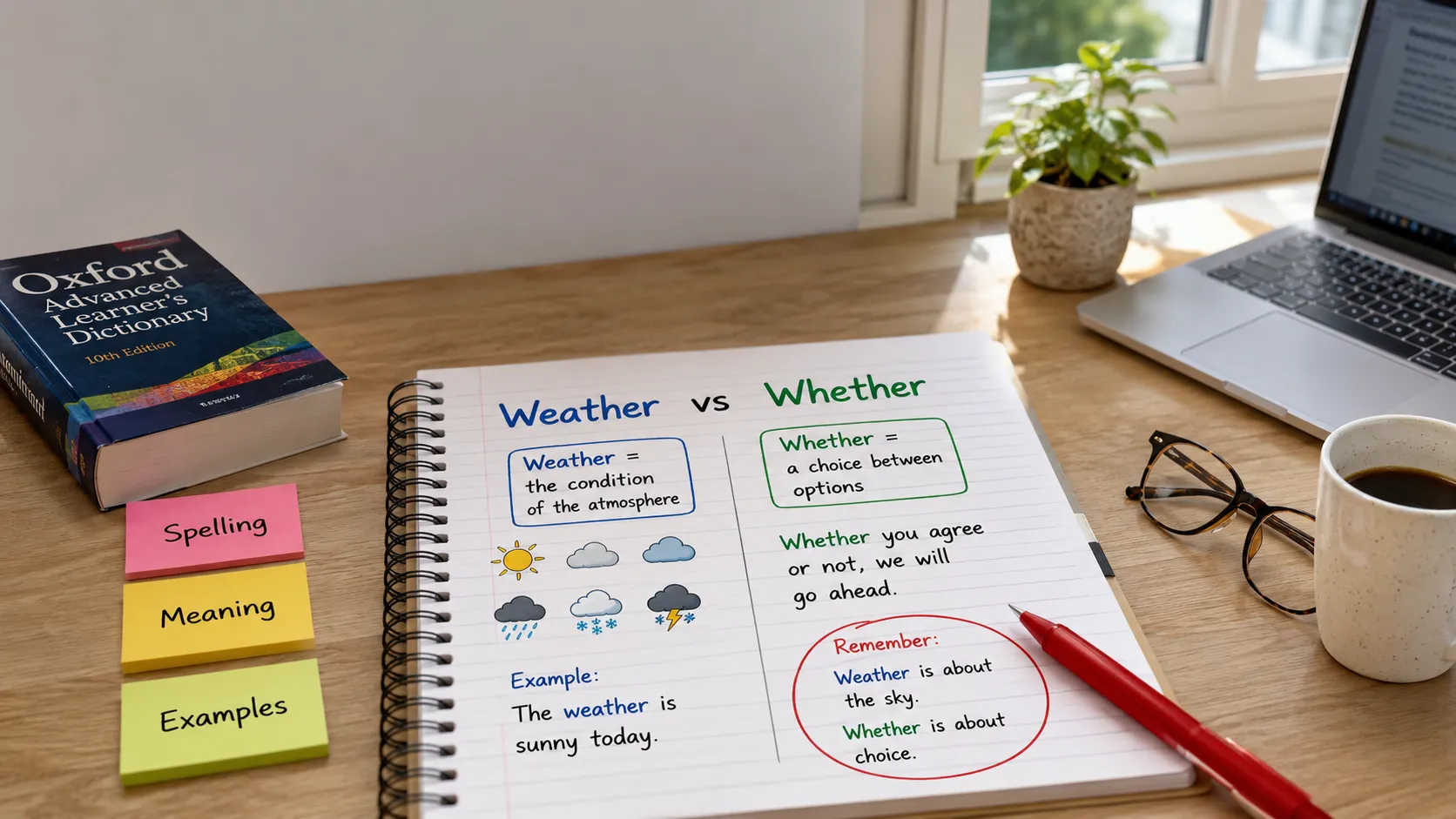
Weather is about the atmosphere, such as rain, sunshine, wind, or snow. Whether is a conjunction that means if or expresses a choice between two or more possibilities.
Have you ever paused while writing and wondered, “Should I use weather or whether?” I know I have.
Years ago, while helping a student edit an essay, I noticed the sentence, “I don’t know weather I should apply today.” It looked almost right because the words sound exactly the same. Yet one small spelling mistake changed the meaning completely. That moment reminded me how tricky English homophones can be.
Many learners, students, and even native speakers mix up weather and whether because they are pronounced the same. Your spell checker may not even catch the mistake because both are real English words.
If you’ve ever felt unsure, you’re in the right place. By the end of this guide, you’ll know the difference, remember it easily, and use both words with confidence in school, work, emails, and everyday conversations.
Weather or Whether – Quick Answer
The difference is simple.
- Weather is a noun. It describes outdoor conditions like sunshine, rain, snow, wind, or storms.
- Whether is a conjunction. It introduces choices or means if.
Simple Examples
✅ The weather is sunny today.
✅ I don’t know whether she will come.
A quick memory trick:
- Weather has “ea,” like earth and sea, both connected to nature.
- Whether starts with “wh,” like which, because it often introduces a choice.
The Origin and Background of Weather or Whether
Although these words sound alike today, they have different histories.
Weather
The word weather comes from the Old English word “weder.” It referred to the state of the sky and the atmosphere. Over hundreds of years, the spelling changed, but the meaning stayed almost the same.
Today, we use weather when talking about:
- Rain
- Snow
- Sunshine
- Temperature
- Wind
- Storms
Whether
Whether also comes from Old English. It developed from a word meaning which of two or which one.
Over time, it became the conjunction we use today to introduce possibilities or alternatives.
For example:
- Whether you win or lose.
- Whether it rains or not.
Even though both words have different origins, English pronunciation gradually made them sound identical. That is why people confuse them.
Weather or Whether Explained : Key Differences
Here is the easiest way to remember them.
| Term | Meaning | When to Use | Context |
| Weather | Outdoor conditions | Talking about rain, sunshine, temperature, wind | Nature, climate |
| Whether | If; expressing a choice | Talking about decisions, possibilities, or alternatives | Grammar, writing |
Weather Examples
- The weather is cold.
- Bad weather delayed the flight.
- We checked the weather before hiking.
Whether Examples
- Tell me whether you agree.
- She wondered whether the test was difficult.
- I cannot decide whether to stay or leave.
Notice the difference.
Weather talks about nature.
Whether talks about choices.
Which Version Should You Use?
The answer depends on what you want to say.
For Students
Choose weather if discussing seasons, climate, or forecasts.
Choose whether if writing about decisions or possibilities.
For Business Professionals
Use weather in reports about environmental conditions.
Use whether when discussing options or decisions.
Example:
“We are deciding whether to launch the project next month.”
For Everyday Conversations
Think about your sentence.
Ask yourself:
Am I talking about the sky?
If yes, use weather.
Am I talking about a choice?
If yes, use whether.
This quick question solves the confusion almost every time.
Common Mistakes with Weather or Whether
Here are mistakes many writers make.
| Mistake | Correct Version | Why |
| I don’t know weather she’ll come. | I don’t know whether she’ll come. | Talking about a choice, not climate. |
| The whether is beautiful. | The weather is beautiful. | Refers to outdoor conditions. |
| We discussed the weather to travel tomorrow. | We discussed whether to travel tomorrow. | Expressing a decision. |
| Whether forecast predicts rain. | Weather forecast predicts rain. | Forecast relates to climate. |
| Bad whether caused delays. | Bad weather caused delays. | Talking about storms and conditions. |
Why These Mistakes Happen
- Both words sound exactly alike.
- Spell check may not notice the error.
- Writers often type quickly without checking context.
Reading your sentence aloud and asking what it means usually fixes the mistake.
Weather or Whether in Real-World Examples
Professional Email
We are still deciding whether to hold tomorrow’s outdoor meeting because the weather forecast predicts heavy rain.
Headline
Severe weather affects thousands across the region.
Social Media Post
I don’t care whether it’s sunny or rainy. I’m going hiking
Formal Report
The committee will determine whether additional funding is required after reviewing the results.
Everyday Conversation
Person A: What’s the weather like?
Person B: I’m not sure whether it will rain.
Notice how both words can appear naturally in the same conversation.
Weather or Whether : Data, Trends & Usage
This keyword is searched by thousands of English learners every month because it solves a common spelling problem.
Search Intent
Primary Intent: Informational
People want to know:
- Which spelling is correct
- The meaning of each word
- Grammar rules
- Easy memory tricks
- Real examples
Who Searches Most?
- Students
- ESL learners
- Teachers
- Bloggers
- Professional writers
- Job seekers
Why It Matters Today
Clear writing creates confidence.
Using the wrong word can confuse readers and make your writing look less professional. Learning the difference helps you write more accurately in emails, essays, reports, and online posts.
Weather vs Whether Comparison Table
| Term/Variant | Meaning | Region/Context | Best Used When |
| Weather | Climate and outdoor conditions | Worldwide English | Talking about nature or forecasts |
| Whether | If or expressing alternatives | Worldwide English | Discussing choices or possibilities |
Easy Memory Tricks
Need a fast way to remember?
Remember “Weather = Nature”
Think of:
- Wind
- Rain
- Clouds
- Snow
These all belong to weather.
Remember “Whether = Choice”
Think of questions like:
- Whether to go?
- Whether to stay?
- Whether or not?
If your sentence involves deciding, choose whether.
Practice Sentences
Fill in the blanks.
- The ______ is perfect for a picnic.
- I don’t know ______ she accepted the offer.
- Bad ______ closed the airport.
- Tell me ______ you agree.
- We checked the ______ before leaving.
Answers
- weather
- whether
- weather
- whether
- weather
If you answered all five correctly, you’ve mastered the difference.
Frequently Asked Questions
Q: What does weather or whether mean?
Weather refers to outdoor conditions like rain, sunshine, wind, and temperature. Whether means if or introduces a choice between alternatives.
Q: How do you use weather correctly?
Use weather whenever you’re talking about climate, forecasts, seasons, storms, or outdoor conditions.
Example:
“The weather is warm today.”
Q: How do you use whether correctly?
Use whether when expressing uncertainty, options, or choices.
Example:
“I don’t know whether he is coming.”
Q: Is whether acceptable in formal writing?
Yes. Whether is perfectly correct in formal writing, business communication, academic papers, and professional emails.
Q: Which version is correct: weather or whether?
Both are correct. The right choice depends on your meaning. Use weather for climate and whether for choices.
Q: Where do these words come from?
Both words come from Old English but developed separately. Over time, they came to share the same pronunciation while keeping different meanings.
Q: Can weather and whether appear in the same sentence?
Yes.
Example:
“We don’t know whether the weather will improve tomorrow.”
Conclusion
The difference between weather and whether is much easier than it first appears. Weather always relates to the atmosphere, including rain, sunshine, snow, wind, and temperature. Whether, on the other hand, introduces choices, uncertainty, or alternatives.
Whenever you’re unsure, pause for a second and ask yourself a simple question. Am I talking about the sky or about a decision? If it’s the sky, choose weather. If it’s a choice, choose whether.
Small spelling differences can make a big impact on your writing. Once you understand this pair, you’ll avoid one of the most common English mistakes and write with greater confidence in emails, school assignments, social media posts, and professional documents.
Bookmark this guide so you never second-guess weather or whether again, and share it with anyone who finds these two words confusing.
Drier or Dryer: Complete Guide to the Correct Usage

Ifrah Maqsood is an English author passionate about creating articles that inspire and engage users.
Their work explores imagination, emotion, and the human experience across diverse themes.
Through their writing, they aim to leave a lasting impact on audiences around the world.