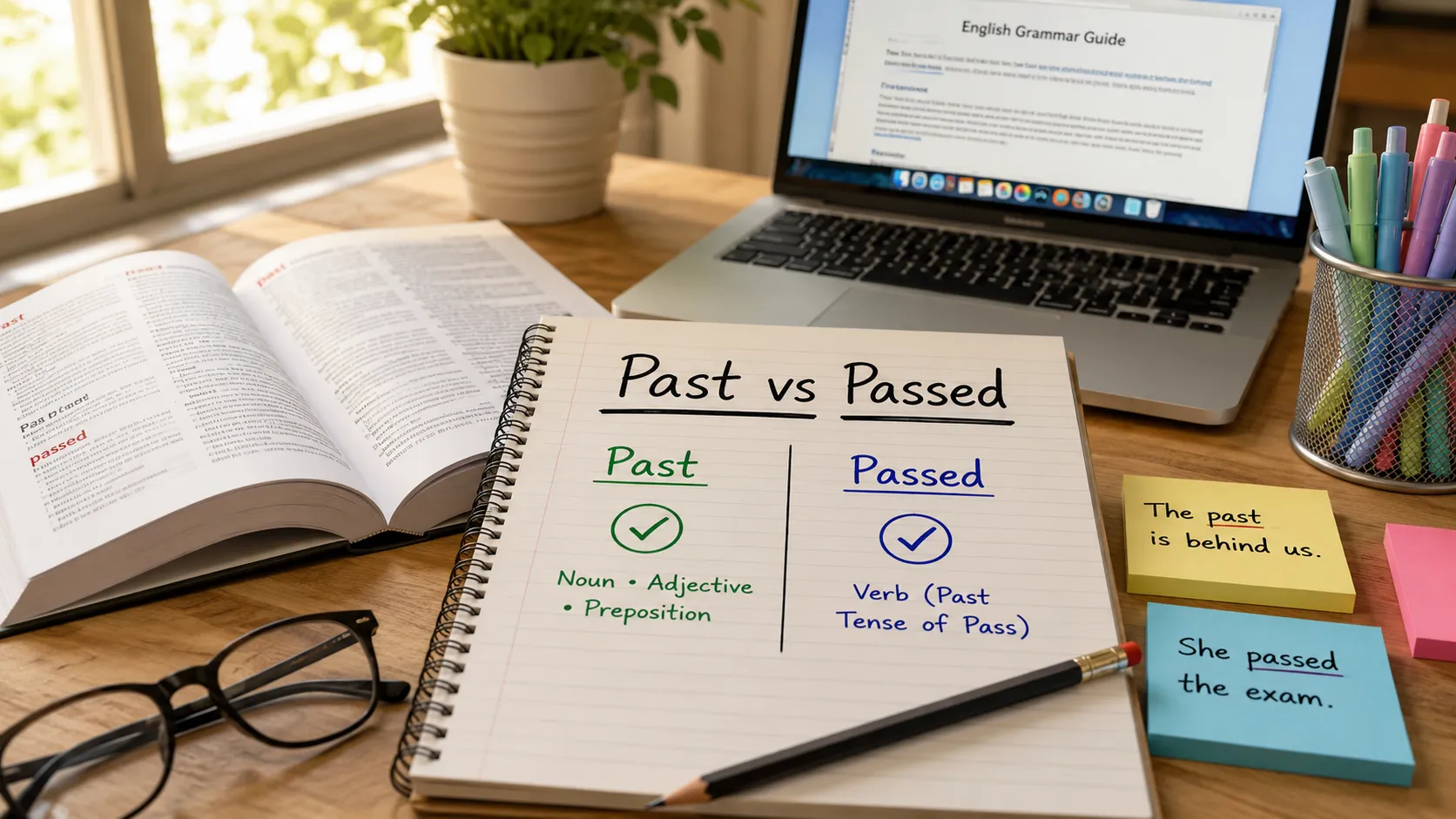
Past usually refers to time that has already happened or can describe something earlier. Passed is the past tense of the verb “pass,” meaning to move by, succeed, hand over, or complete something.
I still remember proofreading one of my first articles and spotting a sentence that read, “The car past me on the highway.” At first glance, it looked fine. Then I realized it should have been “The car passed me on the highway.” That tiny mistake completely changed the grammar.
If you’ve ever paused while writing because you weren’t sure whether to use past or passed, you’re far from alone. These two words sound exactly the same, which makes them easy to confuse. Even experienced writers mix them up from time to time.
The good news is that the difference is simple once you know one easy rule. By the end of this guide, you’ll know when to use each word, avoid common mistakes, and write with confidence in emails, essays, social media posts, and professional documents.
Let’s clear up the confusion once and for all.
Past or Passed – Quick Answer
The easiest way to remember the difference is this:
- Past is usually a noun, adjective, adverb, or preposition related to time or position.
- Passed is always the past tense of the verb “pass.”
Examples
✅ We talked about the past.
✅ She passed the driving test.
✅ Walk past the library.
✅ Time passed quickly.
Quick memory trick:
If you can replace the word with “went by” or “moved,” use passed. Otherwise, past is probably correct.
The Origin and Background of Past or Passed
Although they sound alike today, past and passed developed differently.
The word past comes from Old English and has always been connected with something that has already happened or something beyond a particular point.
The word passed comes from the verb pass, which entered English through Old French. It means to move from one place to another, finish something, or transfer something.
Because English pronunciation changed over time, both words now sound identical. They became homophones: words that sound the same but have different meanings and spellings.
That is why so many people confuse them in writing.
Past or Passed Explained : Key Differences
Although they look similar, these words do different jobs.
| Term | Meaning | When to Use | Region/Context |
| Past | Earlier time or beyond something | Talking about time, direction, or position | British and American English |
| Passed | Past tense of pass | Showing an action already completed | British and American English |
Use Past When Talking About Time
Examples:
- The past cannot be changed.
- During the past year, sales increased.
- Forget the past and move forward.
Use Past for Position
Examples:
- Walk past the bank.
- She drove past my house.
- We ran past the finish line.
Use Passed for Actions
Examples:
- He passed the exam.
- They passed the ball.
- The teacher passed out worksheets.
- Several hours passed before help arrived.
Which Version Should You Use?
Your choice depends on what you want to say.
For Students
Use past when discussing history or earlier events.
Example:
- We studied the past century.
Use passed for completed actions.
Example:
- I passed my math test.
For Professionals
In emails and reports, double-check whether you’re describing an action or referring to time.
Correct:
- The deadline has passed.
- During the past month, profits increased.
For Everyday Writing
Ask yourself one question:
Is someone doing an action?
- Yes → Passed
- No → Past
This simple question solves most mistakes.
Common Mistakes with Past or Passed
Here are mistakes people make every day.
| Mistake | Correct Version | Why |
| She past the exam. | She passed the exam. | It’s an action. |
| We drove passed the school. | We drove past the school. | It shows direction. |
| The passed year was busy. | The past year was busy. | It refers to time. |
| Time past quickly. | Time passed quickly. | The verb is needed. |
| Walk passed the door. | Walk past the door. | It indicates position. |
Why These Errors Happen
- Both words sound exactly alike.
- Spell check may not catch the mistake.
- Writers often focus on pronunciation instead of grammar.
Past or Passed in Real-World Examples
Professional Email
We reviewed the past quarter’s results, and everyone passed the required compliance training.
News Headline
Storm Passed Overnight, Roads Reopen This Morning
Social Media Post
Can’t believe how fast this year has passed!
Formal Report
During the past six months, customer satisfaction improved by 18%.
Past or Passed : Data, Trends & Usage
The keyword past or passed attracts informational search intent. People usually search it when writing essays, emails, homework, or professional documents.
Interest stays steady throughout the year because students, teachers, writers, editors, and English learners regularly need help with confusing word pairs.
English learners in countries where English is taught as a second language frequently search this topic because pronunciation makes the two words nearly impossible to distinguish by sound alone.
As online writing becomes more common, mastering commonly confused words like past and passed matters more than ever. Clear writing builds confidence and credibility.
Standalone Comparison Table
| Term/Variant | Meaning | Region/Context | Best Used When |
| Past | Earlier time | Worldwide | Talking about history or previous events |
| Past | Beyond a place | Worldwide | Giving directions |
| Passed | Moved by | Worldwide | Describing movement |
| Passed | Completed successfully | Worldwide | Talking about exams or tests |
| Passed | Finished or ended | Worldwide | Describing time or events |
Easy Memory Tricks
Remember these simple tips.
Trick 1
If it’s an action, choose passed.
Example:
- She passed me.
Trick 2
If you’re talking about time, choose past.
Example:
- The past week was busy.
Trick 3
If you can replace the word with went by, use passed.
Example:
- Three hours passed.
- Three hours went by.
The sentence still makes sense.
FAQs
Q: What does past mean?
A: Past refers to an earlier time or something beyond a certain point. It is not usually a verb.
Q: What does passed mean?
A: Passed is the past tense of pass. It describes an action that has already happened, such as moving, completing, or succeeding.
Q: How do I know whether to use past or passed?
A: Ask yourself whether the sentence describes an action. If yes, use passed. If it refers to time or position, use past.
Q: Which is correct: “passed away” or “past away”?
A: Passed away is correct. It uses the verb passed as part of the expression meaning someone has died.
Q: Is “walk passed the store” correct?
A: No. The correct phrase is walk past the store because past shows direction.
Q: Can past be a noun?
A: Yes. For example, “Leave the past behind.” Here, past refers to previous events or experiences.
Q: Why do people confuse past and passed?
A: They are homophones. They sound exactly the same but have different meanings and grammatical functions.
Conclusion
The difference between past and passed is much easier than it first appears. Past usually relates to time or position, while passed is always the past tense of the verb “pass.” Whenever you’re unsure, ask whether the sentence describes an action. If it does, passed is almost always the correct choice.
A single letter may seem small, but choosing the right word makes your writing clearer and more professional. Whether you’re writing an email, completing schoolwork, publishing a blog, or posting on social media, using these words correctly helps your message shine.
The next time you hesitate between past and passed, remember the simple rule you’ve learned today. With a little practice, you’ll choose the right word without even thinking.
Bookmark this guide so you never second-guess past or passed again, and share it with someone who struggles with commonly confused English words.
Whether or Wether: Complete Guide to the Correct Spelling

Ifrah Maqsood is an English author passionate about creating articles that inspire and engage users.
Their work explores imagination, emotion, and the human experience across diverse themes.
Through their writing, they aim to leave a lasting impact on audiences around the world.