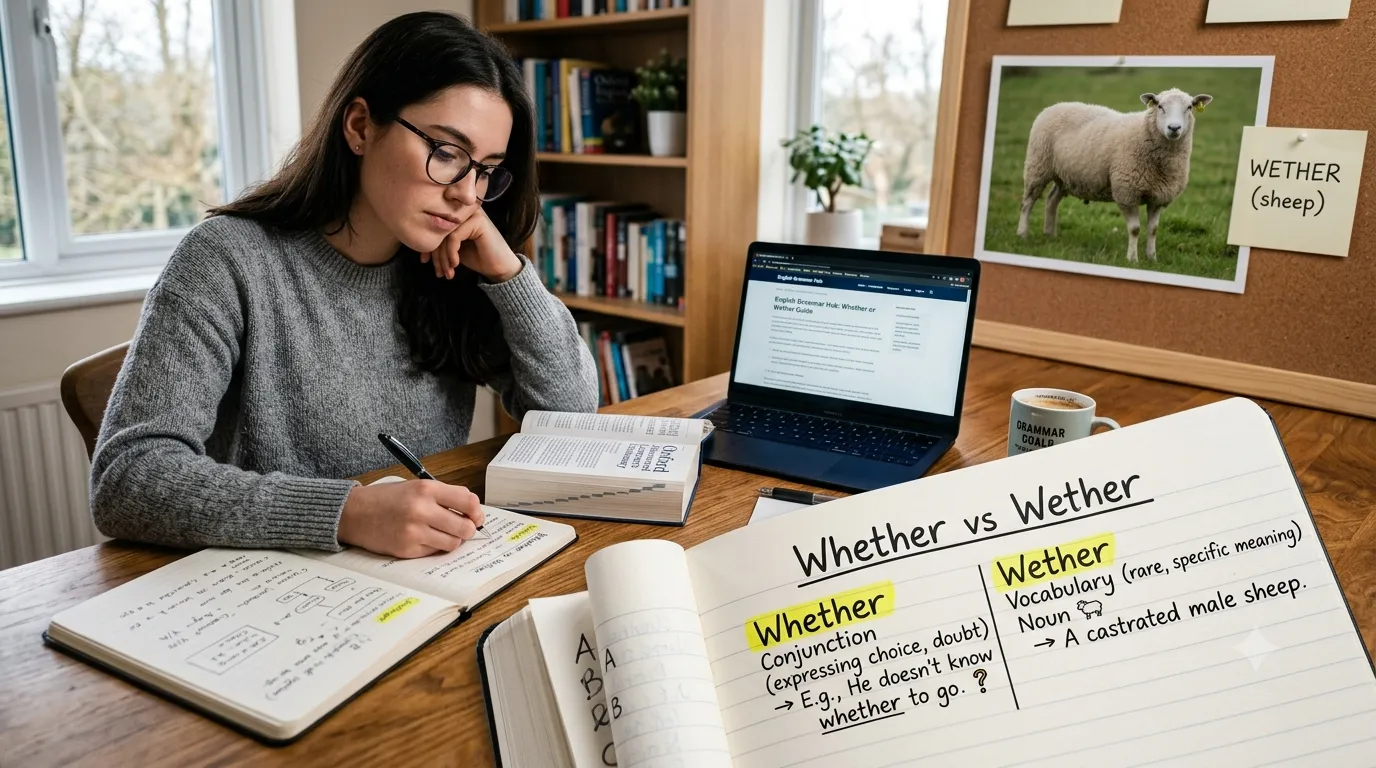
Whether is the correct English word used to show a choice or uncertainty. Wether is a real word too, but it means a castrated male sheep and is rarely used outside farming.
Whether or Wether: Complete Guide to the Correct Spelling
Have you ever paused while writing an email and wondered, “Is it whether or wether?” I certainly have. Early in my writing journey, I typed wether instead of whether in an important article. My spell checker didn’t flag it because wether is actually a real English word. That tiny mistake taught me an important lesson: not every correctly spelled word is the right word.
Many English learners make the same mistake. The words look almost identical, yet they have completely different meanings. One appears in everyday conversations, books, exams, and business emails. The other is a farming term that most people never use.
If you’ve searched for whether or wether, you’re probably looking for a quick answer and a simple explanation. You’re in the right place. By the end of this guide, you’ll know which spelling to use, why people confuse them, and how to remember the difference forever.
Let’s clear up the confusion once and for all.
Whether or Wether – Quick Answer
The correct word in almost every situation is whether.
Use whether when talking about choices, alternatives, or uncertainty.
Examples:
- I don’t know whether she will come.
- Please tell me whether you agree.
- We’re deciding whether to travel this weekend.
The word wether is completely different. It refers to a castrated male sheep. Unless you’re discussing livestock or agriculture, you almost never need this word.
Quick tip: If your sentence means if, choice, or decision, use whether.
The Origin / Background of Whether or Wether
The confusion exists because both words are correctly spelled English words. They differ by only one letter, making them easy to mix up.
The history of whether
The word whether comes from Old English hwæther, meaning which of two or which one. Over time, its meaning expanded to express doubt, alternatives, or uncertainty.
Today, it is one of the most common conjunctions in English.
The history of wether
The word wether has a very different origin. It comes from Old English weðer, referring to a castrated ram. Farmers have used this word for hundreds of years.
Outside agriculture, however, it is rarely seen.
That’s why many people have never encountered it before. When they accidentally type wether, they don’t realize they’ve chosen a different word instead of making a spelling mistake.
Whether or Wether Explained : Key Differences
Although these words look similar, they belong to completely different parts of everyday English.
| Term | Meaning | When to Use | Region/Context |
| Whether | Expresses choice, possibility, or uncertainty | Everyday English, writing, speaking, exams | Worldwide |
| Wether | A castrated male sheep | Farming, agriculture, veterinary writing | Agricultural contexts |
Whether
Use whether whenever you’re talking about two or more possibilities.
Examples:
- I’m unsure whether it will rain.
- She asked whether I liked coffee.
- They couldn’t decide whether to stay or leave.
Wether
Use wether only when referring to sheep.
Example:
- The farmer separated the wether from the flock.
Most English speakers may never need this word in daily life.
Common Situations Where You Need Whether
You’ll see whether in many types of writing.
Questions
- I don’t know whether he’s ready.
- She asked whether I finished.
Decisions
- We’re discussing whether to buy a house.
- He couldn’t decide whether to apply.
Formal Writing
Business emails often use whether because it sounds more precise than if.
Example:
Please confirm whether you will attend the meeting.
Academic Writing
Teachers and professors frequently use whether in essays and research papers.
Example:
The study examined whether exercise improves memory.
Why People Confuse Whether and Wether
Several reasons explain this common mistake.
- Both words contain almost the same letters.
- Spell check doesn’t always catch the error.
- Most people have never learned the meaning of wether.
- Fast typing often causes letters to be skipped.
- Pronunciation is nearly identical.
Because wether is a legitimate English word, grammar tools may not warn you.
That’s why understanding the meaning is more important than relying only on spell check.
Easy Memory Trick
Here’s a simple trick I teach students.
Think about whether.
Notice the word “he” inside it.
Whenever you’re asking whether something will happen, you’re thinking about a choice.
Another trick:
Whether = Which?
Both begin with Wh.
Whenever you’re choosing between options, use whether.
For wether, think about the letter t standing for the sheep on the farm.
It sounds silly, but memorable tricks work.
Whether vs If
Many learners also confuse whether and if.
Although they are often interchangeable, they aren’t always the same.
| Whether | If |
| Used for choices | Often used for conditions |
| More formal | More conversational |
| Preferred in formal writing | Preferred in casual speech |
| Correct before “or not” | Sometimes sounds awkward before “or not” |
Examples:
✔ I don’t know whether she’ll come.
✔ I don’t know if she’ll come.
But:
✔ I don’t know whether or not she’ll come.
❌ I don’t know if or not she’ll come.
In formal English, whether is usually the safer choice.
Common Mistakes with Whether or Wether
Here are mistakes many writers make.
| Mistake | Correct |
| I don’t know wether it’s true. | I don’t know whether it’s true. |
| Tell me wether you agree. | Tell me whether you agree. |
| We discussed wether to leave. | We discussed whether to leave. |
| Please confirm wether you’ll attend. | Please confirm whether you’ll attend. |
| I can’t decide wether to go. | I can’t decide whether to go. |
Notice something?
Every incorrect example talks about a choice, not a sheep.
That makes whether the correct word every time.
Which Version Should You Use?
For almost everyone, the answer is simple: use “whether.”
The word wether is correct only in a very specific situation. Unless you’re writing about sheep, farming, or animal science, you won’t need it.
For students
Use whether in:
- Essays
- Homework
- Exams
- Research papers
Example:
The teacher asked whether we had finished the assignment.
For professionals
Business writing should almost always use whether because it is clear and formal.
Example:
Please let us know whether you accept the proposal.
For content writers and bloggers
Choose whether whenever you’re expressing uncertainty or offering alternatives.
Example:
Readers often wonder whether organic food is worth the extra cost.
For farmers and veterinarians
Use wether only when referring to a castrated male sheep.
Example:
The wether was moved to a separate pasture.
Best recommendation
If your sentence means “if,” “choice,” or “or not,” always use whether.
Whether or Wether in Real-World Examples
Seeing words in context makes them easier to remember.
Professional Email
Dear Sarah,
Please confirm whether you will attend Friday’s meeting so we can finalize the schedule.
News Headline
Scientists Study Whether Daily Exercise Improves Brain Health
Social Media Post
Still deciding whether to watch the new movie tonight. Any recommendations?
Formal Report
The committee evaluated whether the proposed policy would improve workplace safety.
Agriculture Example
The farmer separated the wether from the breeding flock.
Notice how different the last example feels. That’s because wether belongs to farming, not everyday English.
Whether or Wether : Data, Trends & Usage
The search term “whether or wether” is popular because many people type the wrong spelling without realizing it.
Search Intent
Primary intent: Informational
People want to know:
- Which spelling is correct.
- What each word means.
- Whether both words are real.
- How to avoid making mistakes.
Who Searches for This Topic?
The topic is especially popular among:
- English learners
- Students
- Bloggers
- Teachers
- Professional writers
- Job seekers
- Business professionals
Where Is It Most Common?
English-speaking countries such as:
- United States
- United Kingdom
- Canada
- Australia
- New Zealand
It is also searched frequently by people learning English as a second language around the world.
Why It Matters Today
Grammar tools have improved, but they cannot always detect correctly spelled words used in the wrong context.
Since wether is a real dictionary word, your writing software may not highlight the mistake.
Understanding the meaning helps you write with confidence.
Whether or Wether Comparison Table
| Term/Variant | Meaning | Region/Context | Best Used When |
| Whether | Expresses uncertainty or choice | Everyday English worldwide | Talking about alternatives, decisions, or possibilities |
| Wether | A castrated male sheep | Farming and agriculture | Referring to livestock |
Frequently Asked Questions
Q: What does “whether” mean?
A: Whether is a conjunction used to show a choice, uncertainty, or alternatives. It often means “if” when discussing two or more possibilities.
Q: Is “wether” a real English word?
A: Yes. Wether is a genuine English word, but it refers to a castrated male sheep. It is rarely used outside farming or animal science.
Q: Which spelling is correct: whether or wether?
A: If you’re talking about decisions, uncertainty, or alternatives, whether is correct. Use wether only when discussing sheep.
Q: Can I use “whether” instead of “if”?
A: Sometimes, yes. In many sentences, whether and if have similar meanings. However, whether is preferred in formal writing and before the phrase “or not.”
Q: Is “whether” acceptable in formal writing?
A: Absolutely. It is widely used in academic papers, business emails, legal documents, and professional reports because it sounds precise and clear.
Q: Where does the word “whether” come from?
A: It comes from Old English and originally meant “which of two.” Over time, it developed its modern meaning of expressing alternatives or uncertainty.
Q: Can “wether” be used in everyday conversation?
A: Usually not. Unless you’re talking about sheep or farming, you almost never need the word wether.
Conclusion
By now, the difference between whether or wether should feel much clearer.
Remember these key points:
- Whether is the word you’ll use in everyday English.
- It expresses choices, alternatives, and uncertainty.
- Wether is a real word, but it means a castrated male sheep.
- Because both words are correctly spelled, spell check may not catch the mistake. Understanding their meanings is the best way to avoid errors.
Whenever you stop to wonder which spelling is right, ask yourself a simple question: Am I talking about a decision or a sheep? If it’s a decision, the answer is almost always whether.
The more you read and write, the more natural this distinction will become. Soon, you won’t have to think twice before choosing the correct word.
Now you know exactly how to use whether correctly. Bookmark this guide for future reference, and share it with anyone who’s ever been confused by “whether or wether.”
Meta Description
Whether or wether explained: learn correct spelling, meanings, usage, examples, differences, avoid mistakes, and write confidently every time today.
Bougie or Boujee: Complete Guide to Meaning & Usage

Ifrah Maqsood is an English author passionate about creating articles that inspire and engage users.
Their work explores imagination, emotion, and the human experience across diverse themes.
Through their writing, they aim to leave a lasting impact on audiences around the world.