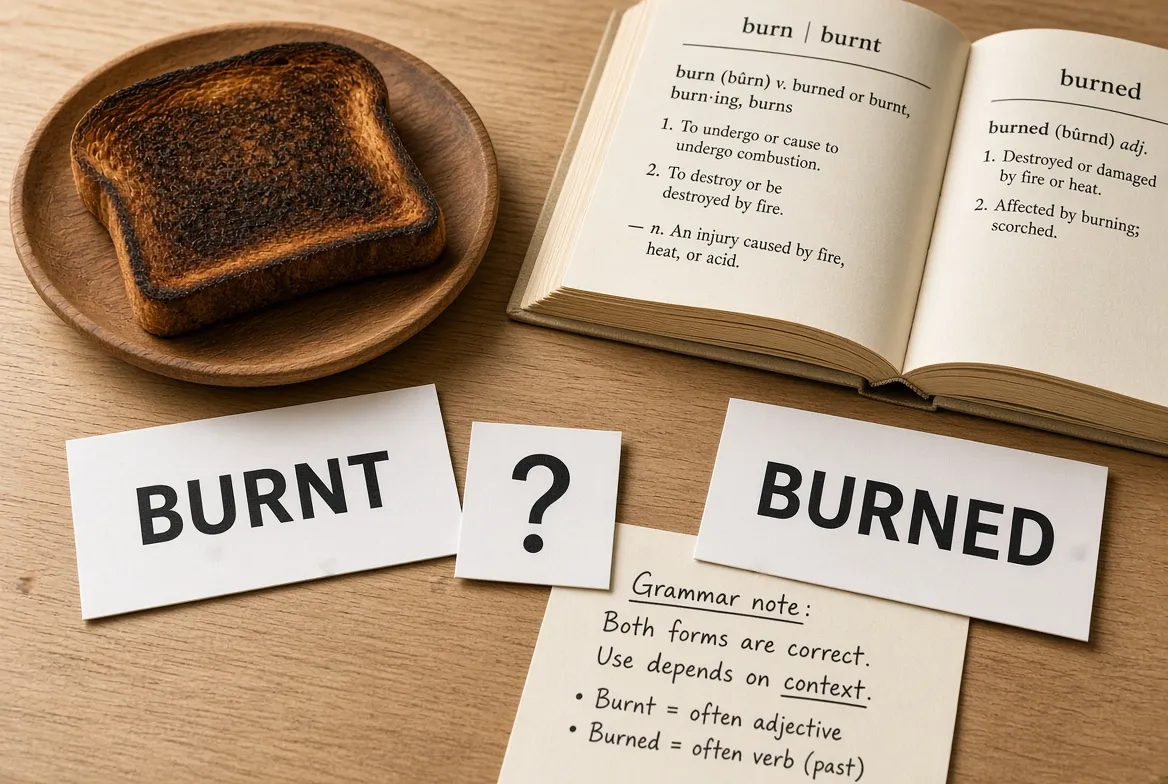
Both burnt and burned are correct spellings. Burned is the preferred form in American English, while burnt is more common in British English, especially as an adjective (for example, burnt toast).
Have you ever stopped while writing and wondered whether to use burnt or burned? You are not alone. Many English learners, students, and even native speakers get confused because both words are correct. The difference depends mostly on where you live and how you use the word.
Understanding burnt or burned helps you write more naturally and avoid common spelling mistakes. American English usually prefers one form, while British English often uses the other. In some cases, both can even appear in the same sentence with slightly different meanings.
This guide explains the difference in simple words. You’ll learn when to use each spelling, how they developed, where they are most common, and which one is best for your audience. By the end, you’ll know exactly which word fits your writing
Burnt or Burned – Quick Answer
Both burnt and burned are correct.
- Burned is the preferred past tense and past participle in American English.
- Burnt is more common in British English, especially as an adjective.
Examples
- I burned my hand on the stove.
- The toast is burnt.
- The firefighters quickly put out the burned building.
The Origin of Burnt or Burned
The word burn comes from Old English byrnan and beornan, meaning “to be on fire.”
Over time, English developed two past forms:
- Burned followed the regular “-ed” pattern.
- Burnt remained as an older irregular form.
British English kept burnt in everyday use, while American English gradually preferred burned. Today, both spellings are accepted, but their popularity differs by region.
British English vs American English Spelling
The biggest difference is regional preference.
| Version | Spelling | Region | Example Sentence |
|---|---|---|---|
| Past tense | Burned | United States | She burned the letter. |
| Past tense | Burnt | United Kingdom | She burnt the letter. |
| Adjective | Burnt | UK/Commonwealth | The burnt toast smelled bad. |
| Adjective | Burned | US | The burned house needed repairs. |
Simple Rule
- American English: Prefer burned.
- British English: Burnt and burned are both acceptable, but burnt is often more common.
Which Spelling Should You Use?
For a US Audience
Use burned in almost every situation.
Example:
- He burned the pizza.
For a UK or Commonwealth Audience
You can use either spelling, but burnt often sounds more natural.
Example:
- The burnt cookies tasted bitter.
For a Global or SEO Audience
Choose burned if most readers are American.
Choose burnt when writing for British readers or when describing something as an adjective.
Common Mistakes with Burnt or Burned
Here are mistakes people often make.
| Incorrect | Correct |
|---|---|
| I have burnt my homework. (US writing) | I have burned my homework. |
| The burned toast tasted awful. (UK preference) | The burnt toast tasted awful. |
| Burnt is always wrong. | Both spellings are correct. |
| Burned is only American. | Burned is accepted worldwide. |
Tips
- Match the spelling to your audience.
- Stay consistent throughout your document.
- Remember that burnt is especially common as an adjective.
Burnt or Burned in Everyday Examples
Emails
I accidentally burned the report while testing the machine.
News Headlines
Several homes were burned during the wildfire.
Social Media
I totally burnt my dinner tonight! 😂
Formal Writing
The burned documents could not be recovered.
Burnt or Burned – Google Trends & Usage
Search interest for burned is generally stronger in the United States because it follows American spelling rules.
In the United Kingdom, Australia, and New Zealand, burnt appears more often, especially when describing food or objects.
Worldwide, both spellings are widely recognized. Search engines understand both forms, so choosing the right spelling mainly depends on your target audience rather than search rankings.
Burnt vs Burned Comparison Table
| Feature | Burned | Burnt |
|---|---|---|
| Correct spelling | ✅ Yes | ✅ Yes |
| American English | Preferred | Less common |
| British English | Correct | Very common |
| Past tense | Yes | Yes |
| Past participle | Yes | Yes |
| Adjective | Common | Very common |
| Formal US writing | Recommended | Less common |
| Everyday UK writing | Accepted | Preferred |
FAQs
Is burnt or burned correct?
Both are correct. The preferred spelling depends on whether you use American or British English.
Is burnt British English?
Yes. Burnt is more common in British English, especially as an adjective.
Is burned American English?
Yes. American English usually prefers burned for both the past tense and past participle.
Can I use burnt in formal writing?
Yes, especially in British English. In American English, burned is generally preferred.
Why are there two spellings?
English has kept both an older irregular form (burnt) and the regular “-ed” form (burned).
Is burnt only an adjective?
No. It can also be used as a past tense in British English, although it is especially common as an adjective.
Which spelling is better for international readers?
Use the spelling that matches your audience. Burned works well for American readers, while burnt feels more natural to many British readers.
Conclusion
Choosing between burnt or burned is easier once you know the difference. Both spellings are correct, but they are used differently depending on the type of English you are writing. American English usually prefers burned, while British English often favors burnt, especially when describing something that has been damaged by fire or overcooked.
If you write for an American audience, using burned is the safest choice. If your readers are in the UK or other Commonwealth countries, burnt may sound more familiar. The most important thing is to stay consistent throughout your writing.
Now that you understand burnt or burned, you can write with confidence and choose the spelling that best fits your audience and purpose.
Learn burnt or burned differences, British and American spelling rules, examples, common mistakes, and choose the correct word confidently every time.
Sence or Sense: Which Spelling Is Correct?

Ifrah Maqsood is an English author passionate about creating articles that inspire and engage users.
Their work explores imagination, emotion, and the human experience across diverse themes.
Through their writing, they aim to leave a lasting impact on audiences around the world.