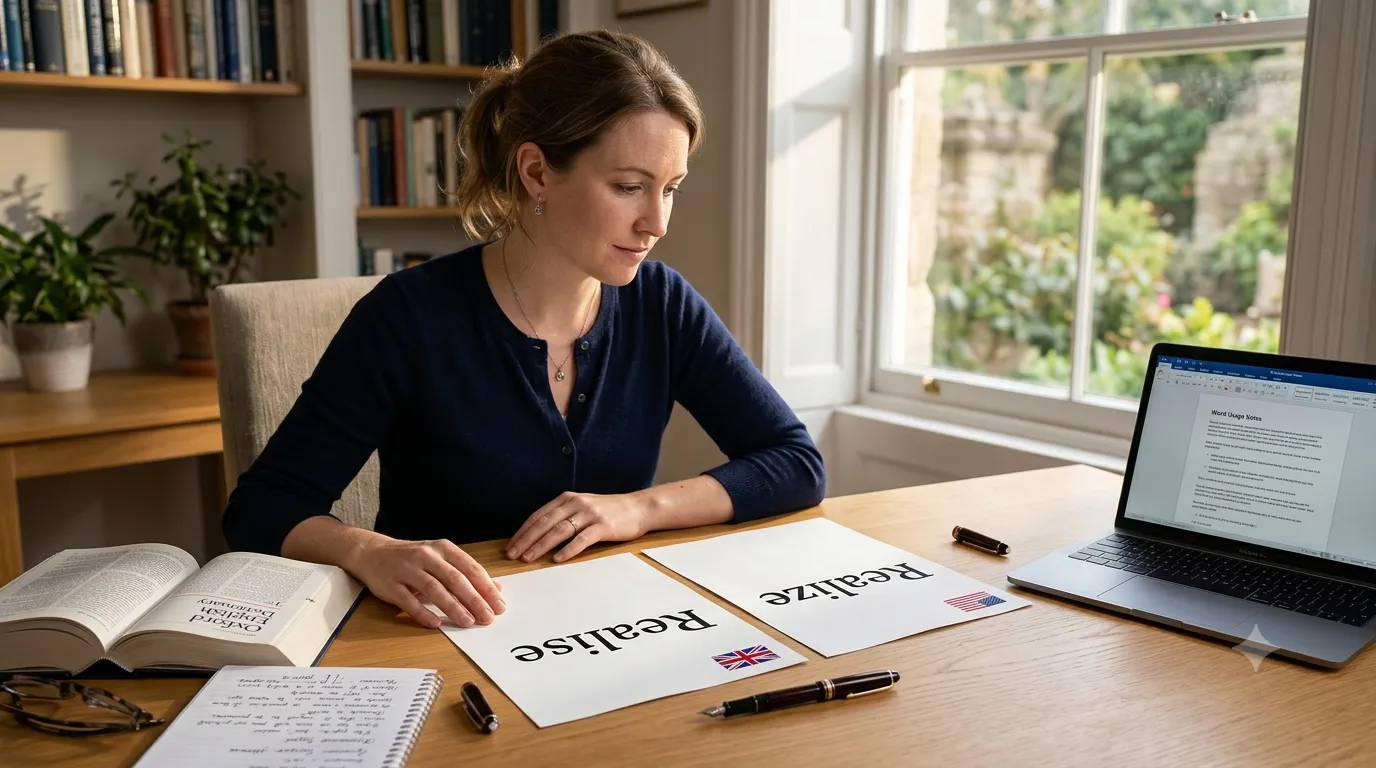
Realise and realize mean exactly the same thing. The only difference is spelling. Realise is the standard spelling in British English, while realize is the preferred spelling in American English.
A few years ago, I was proofreading one of my English articles before publishing it. Everything looked perfect until I noticed I had written realise in one paragraph and realize in another. At first, I thought I had made a grammar mistake. After digging deeper, I discovered something surprising: both spellings are correct. The only difference is the variety of English you are using.
This confusion happens to thousands of writers, students, bloggers, and professionals every day. If you study British English, you often learn realise. If you read American books or websites, you usually see realize instead. Seeing both spellings online can leave anyone wondering which one is actually correct.
If you’ve ever paused before pressing “Send” on an email or questioned your spelling while writing an essay, you’re not alone.
In this guide, you’ll learn the difference between realise or realize, why both spellings exist, when to use each one, and how to avoid common mistakes. By the end, you’ll know exactly which spelling fits your audience and write with complete confidence.
Realise or Realize – Quick Answer
Both realise and realize have the same meaning.
They both mean:
- To become aware of something
- To understand a fact
- To achieve or make something happen
The only difference is the spelling style.
- Realise → British English
- Realize → American English
Examples
British English
I didn’t realise the meeting had been moved.
American English
I didn’t realize the meeting had been moved.
Another example:
British:
She finally realised her dream.
American:
She finally realized her dream.
The meaning never changes. Only the spelling does
The Origin and Background of Realise or Realize
The history behind these spellings is more interesting than many people expect.
Both realise and realize come from the word real, which itself traces back through French and Latin roots. The verb developed in English to describe becoming aware of something or making something real.
Centuries ago, English spelling was far less standardized than it is today. Writers often spelled words in different ways, and both -ise and -ize endings appeared in books and official documents.
Later, American English adopted -ize as the standard spelling. British English gradually preferred -ise, although many respected British publishers still use -ize today.
This surprises many learners because they assume -ize is always American.
In fact, Oxford University Press, one of Britain’s most respected publishers, traditionally prefers -ize spellings, including realize, organize, and recognize.
Meanwhile, most British schools, newspapers, businesses, and style guides teach and use realise.
That means both spellings are accepted in British English, although realise is much more common in everyday writing.
Why Does the Confusion Exist?
Several reasons explain why people search for realise or realize:
- They read both spellings online.
- They switch between British and American English.
- Spell-checkers change one spelling into another.
- International companies use different style guides.
- Schools teach different spelling standards.
The key is consistency. Once you choose British or American English, stick with that spelling throughout your writing.
Realise or Realize Explained : Key Differences
The biggest surprise is that there is no difference in meaning.
The difference is entirely about regional spelling conventions.
| Term | Meaning | When to Use | Region/Context |
| Realise | Become aware or understand | British writing | UK, Australia, New Zealand, South Africa |
| Realize | Become aware or understand | American writing | United States, Canada (often), international business |
Pronunciation
Both words are pronounced exactly the same.
/ˈriː.ə.laɪz/
No matter which spelling you choose, people say the word the same way.
Meaning Examples
Becoming Aware
British:
I didn’t realise how late it was.
American:
I didn’t realize how late it was.
Understanding a Situation
British:
She suddenly realised the answer.
American:
She suddenly realized the answer.
Achieving a Goal
British:
He realised his lifelong ambition.
American:
He realized his lifelong ambition.
Again, the sentence means exactly the same thing.
British English vs American English
Here’s where things become easier.
If your audience is mostly in:
United Kingdom
Use:
✅ Realise
If your audience is mostly in:
United States
Use:
✅ Realize
If your readers come from around the world, either spelling is acceptable: as long as you remain consistent throughout your document.
Which Spelling Is More Common?
Generally:
- British schools teach realise.
- American schools teach realize.
- Most U.S. publishers prefer realize.
- Many UK newspapers prefer realise.
- Some British academic publishers use realize because they follow Oxford spelling.
This is why you may see both spellings even in British publications.
A Simple Memory Trick
Remember this easy tip:
- S in realise = Standard British School Spelling
- Z in realize = American Z Style
While not a formal rule, this memory trick can help you choose the right spelling based on your audience.
Which Version Should You Use?
The best spelling depends on who will read your writing. There is no universal “better” choice. Instead, match your spelling to your audience.
If you’re writing for British readers
Use realise.
This is the spelling taught in most schools and used by many newspapers, businesses, and organizations in the United Kingdom.
Example:
I didn’t realise how much time had passed.
If you’re writing for American readers
Use realize.
It is the standard spelling in the United States and appears in American books, universities, and media.
Example:
I didn’t realize the store was closed.
If you’re writing for an international audience
Either spelling is correct. The most important rule is consistency.
Don’t switch between realise and realize in the same article, report, or email unless you’re discussing the spelling differences themselves.
Quick Recommendations
- Students in the UK → Use realise.
- Students in the US → Use realize.
- Academic writing → Follow your school’s or publisher’s style guide.
- Business writing → Match your company’s preferred English style.
- Blogs and websites → Use the spelling your target audience expects.
Common Mistakes with Realise or Realize
People often make small spelling mistakes because both forms are correct in different regions. Here are the most common ones.
| Mistake | Correct Form | Why? |
| Mixing realise and realize in one document | Pick one spelling and stay consistent | Consistency improves readability. |
| Using realise in American English assignments | Realize | American English prefers -ize. |
| Using realize in British schoolwork (unless Oxford style is required) | Realise | Most British schools teach -ise. |
| Thinking one spelling changes the meaning | Both mean the same thing | Only the spelling differs. |
| Assuming realize is always wrong in Britain | Both are accepted, though realise is more common | Oxford spelling often uses -ize. |
Easy Tip
Before you start writing, decide whether you’re using British English or American English. Then stick with that choice from beginning to end.
Realise or Realize in Real-World Examples
Here is how these spellings appear in everyday writing.
Professional Email
British English
I didn’t realise the meeting had been rescheduled. Thank you for letting me know.
American English
I didn’t realize the meeting had been rescheduled. Thank you for the update.
News Headline
British Style
Scientists realise new findings could improve treatment.
American Style
Scientists realize new findings could improve treatment.
Social Media Post
I just realized I’ve been saying this wrong for years!
or
I only realised today how beautiful this place is.
Formal Report
The company realised significant growth during the last financial year.
American version:
The company realized significant growth during the last fiscal year.
Realise or Realize : Data, Trends & Usage
Interest in realise or realize remains high because English is used worldwide. Learners, writers, editors, and professionals frequently search this topic to ensure they are using the correct spelling for their audience.
Search Intent
- Primary intent: Informational
- Secondary intent: Educational and writing guidance
Who Searches This Topic?
- English language learners
- Students
- Teachers
- Bloggers
- Copywriters
- Editors
- Business professionals
Where Is It Most Relevant?
- United Kingdom
- United States
- Australia
- Canada
- New Zealand
- International companies using English
Why Does It Matter Today?
With remote work, online publishing, and global communication, people regularly write for readers from different countries. Choosing the right spelling helps your writing look professional and builds trust with your audience.
Realise or Realize Comparison Table
| Term/Variant | Meaning | Region/Context | Best Used When |
| Realise | Become aware or understand | British English | Writing for UK, Australia, or most British audiences |
| Realize | Become aware or understand | American English | Writing for the United States or American publications |
Frequently Asked Questions
Q: What does “realise or realize” mean?
Both spellings mean to become aware of something, understand a fact, or make something happen. The meaning is identical.
Q: How do you use realise or realize correctly?
Choose the spelling that matches your audience. Use realise for British English and realize for American English.
Q: Is there any difference between realise and realize?
No. They have the same pronunciation and meaning. The only difference is regional spelling.
Q: Is realise acceptable in formal writing?
Yes. It is perfectly acceptable in formal British English. If you’re writing in American English, use realize instead.
Q: Which spelling is correct: realise or realize?
Both are correct. The right choice depends on whether you’re following British or American English conventions
Q: Why do British and American English spell this word differently?
Over time, spelling standards developed differently in each variety of English. British English generally favors -ise, while American English standardizes -ize.
Q: Can I use realise or realize in academic writing?
Yes. Follow the style guide required by your school, university, publisher, or instructor. Consistency is more important than the specific spelling you choose.
Conclusion
Choosing between realise or realize is much easier once you know the rule. Both spellings are correct, both have the same meaning, and both are pronounced the same way. The only real difference is the variety of English you’re using.
If you’re writing for a British audience, realise is usually the best choice. If your readers are American, realize is the preferred spelling. For international writing, either version works well as long as you stay consistent throughout your document.
The next time you pause over this word, remember that you aren’t choosing between right and wrong. You’re simply choosing the spelling that best matches your audience.
Now you know exactly how to use realise or realize. Bookmark this guide for future reference, and share it with anyone who has ever wondered which spelling is correct.
Whether or Not: Complete Guide to Meaning and Correct Usage

Ifrah Maqsood is an English author passionate about creating articles that inspire and engage users.
Their work explores imagination, emotion, and the human experience across diverse themes.
Through their writing, they aim to leave a lasting impact on audiences around the world.