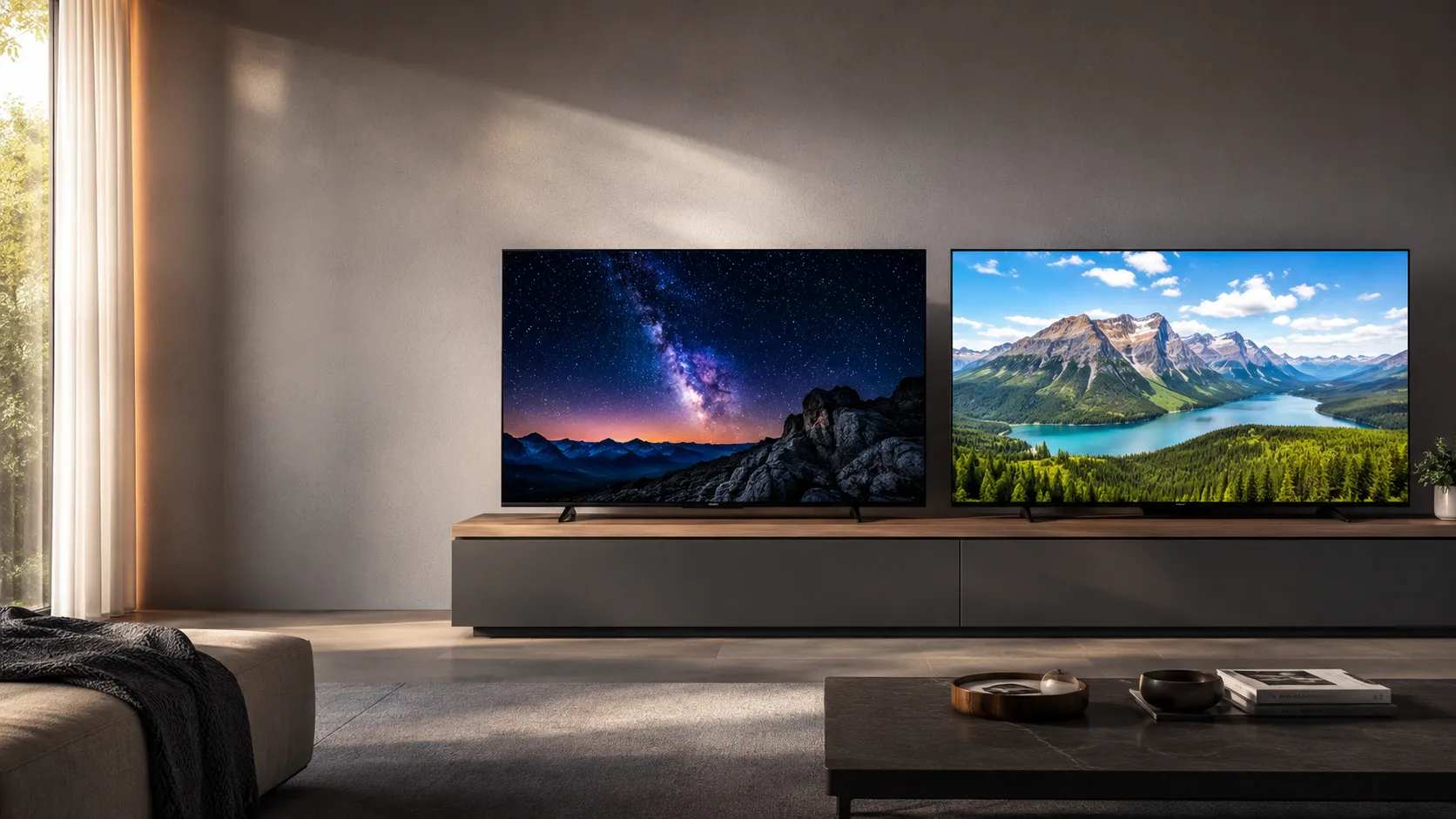
OLED or QLED refers to two different TV display technologies. OLED offers perfect blacks and stunning contrast, while QLED provides brighter images and strong color performance.
The first time I compared an OLED TV and a QLED TV, I thought the choice would be simple. One salesperson praised OLED’s deep blacks, while another highlighted QLED’s brightness and long-lasting performance. I realized many buyers face the same problem: both names sound similar, but they work in very different ways.
When people search for OLED or QLED, they usually want one clear answer: Which TV should I buy for my home? The confusion happens because both technologies promise amazing picture quality, rich colors, and a premium viewing experience.
I have spent years exploring display technology trends, testing how screens perform in real rooms, and explaining technical topics in simple words. I have learned that the “best” choice depends on your habits, room lighting, budget, and what you watch most.
In this guide, you will discover the real differences between OLED and QLED, their strengths, weaknesses, and which one fits your needs better.
Let’s break down the technology behind these popular TV displays.
OLED or QLED – Quick Answer
OLED and QLED are premium TV display technologies, but they create images differently.
OLED (Organic Light-Emitting Diode) uses pixels that create their own light. Each pixel can turn completely off, producing perfect black levels and excellent contrast.
QLED (Quantum Dot Light-Emitting Diode) uses a traditional LED backlight combined with quantum dot technology to improve brightness and color accuracy.
Simple examples:
- Watching a dark movie scene in a bedroom? OLED usually looks better because blacks appear deeper.
- Watching sports in a bright living room? QLED may perform better because it can get much brighter.
The right choice depends on where and how you watch TV.
The Origin and Background of OLED and QLED
Television technology has changed dramatically over the years. Early TVs used large picture tubes, then moved to LCD screens, and later introduced advanced display technologies like OLED and QLED.
What Is OLED?
OLED stands for Organic Light-Emitting Diode.
Unlike older LCD screens, OLED panels do not need a separate backlight. Every individual pixel produces its own light.
This allows OLED TVs to create:
- True black colors
- Extremely high contrast
- Very thin designs
- Excellent viewing angles
OLED technology became popular in high-end televisions because it could reproduce images closer to what the human eye naturally sees.
What Is QLED?
QLED stands for Quantum Dot Light-Emitting Diode.
QLED is an improved version of LED-LCD technology. It uses tiny semiconductor particles called quantum dots that enhance brightness and color output.
QLED TVs became popular because they solved some common LCD problems:
- Better brightness
- More vibrant colors
- Longer lifespan
- Less concern about image retention
Although the names look similar, OLED and QLED are not the same technology.
OLED or QLED Explained : Key Differences
The biggest difference between OLED and QLED is how they produce light.
OLED pixels create their own light.
QLED TVs use a backlight behind the screen.
This single difference affects everything from black levels to brightness.
| Feature | OLED | QLED |
| Technology | Self-lit organic pixels | LED backlight with quantum dots |
| Black Levels | Perfect blacks | Very good blacks, but not always perfect |
| Brightness | Excellent | Usually brighter |
| Contrast | Outstanding | Good to excellent |
| Viewing Angle | Wider | More limited |
| Color Quality | Natural and accurate | Very bright and vivid |
| Screen Thickness | Extremely thin | Usually thicker |
| Gaming Performance | Excellent response time | Excellent with modern models |
| Lifespan | Very good | Often longer-lasting |
| Best For | Movies, dark rooms, premium viewing | Sports, bright rooms, general entertainment |
OLED vs QLED: Detailed Comparison
1. Picture Quality
OLED usually wins when it comes to pure picture quality.
Because each pixel controls its own brightness, OLED can show a bright object next to complete darkness without light leaking into nearby areas.
For example:
A star-filled night sky in a movie can look more realistic on an OLED screen.
QLED TVs still provide excellent images, but their backlight system may create small areas of unwanted brightness called blooming.
2. Brightness Performance
QLED has a major advantage in brightness.
A bright room with sunlight coming through windows can reduce the impact of some OLED displays. QLED TVs are designed to handle strong lighting conditions.
For:
- Daytime sports viewing
- Bright family rooms
- Large windows
QLED can be a better choice.
3. Gaming Experience
Both OLED and QLED can be great for gaming.
OLED offers:
- Faster response time
- Deep contrast
- Smooth motion
QLED offers:
- High brightness
- Strong colors
- No major concern about static images
Modern gaming TVs from both categories support features like:
- HDMI 2.1
- High refresh rates
- Variable refresh rate (VRR)
4. Price Difference
OLED TVs are usually more expensive because the technology is more advanced.
QLED TVs often provide excellent value because they deliver premium features at a lower price range.
If you want luxury picture quality and have a flexible budget, OLED is attractive.
If you want strong performance without spending the maximum amount, QLED is often the smarter choice.
Standalone Comparison Table: OLED or QLED
| Term/Variant | Meaning | Region/Context | Best Used When |
| OLED | Self-lit display technology using organic pixels | Premium TVs, smartphones, home theaters | You want perfect blacks and cinematic picture quality |
| QLED | LED display improved with quantum dot technology | Bright rooms, mainstream premium TVs | You need high brightness and vibrant colors |
| OLED TV | Television using OLED panels | Movies, gaming, dark environments | You want the best contrast |
| QLED TV | Television using quantum dot LED panels | Sports, family rooms, everyday viewing | You want durability and brightness |
Which Version / Approach Should You Use?
Choosing between OLED or QLED is not about finding a winner for everyone. It is about finding the screen that matches your lifestyle.
A movie lover may prefer OLED, while a sports fan may enjoy QLED more. Your room, viewing habits, and budget matter just as much as the technology itself.
Here is a simple guide:
For Movie Lovers → Choose OLED
If you enjoy:
- Dark movie scenes
- Cinematic experiences
- Watching films at night
- Premium picture quality
OLED is usually the better choice.
The perfect blacks make shadows look deeper and scenes feel more realistic. Horror, science fiction, and dramatic movies often look amazing on OLED screens.
For Bright Rooms → Choose QLED
If your TV sits in:
- A sunny living room
- A room with large windows
- A bright family area
QLED may be the better option.
Its higher brightness helps images stay clear even when sunlight enters the room.
For Gamers → Consider Both
Gaming performance depends on the specific TV model, not only the display type.
Choose OLED if you want:
- Faster pixel response
- Better dark scenes
- Smooth motion
Choose QLED if you want:
- High brightness
- Long gaming sessions
- Strong color output
Both can deliver an excellent gaming experience.
For Budget-Conscious Buyers → Choose QLED
QLED TVs often provide excellent value.
You can get:
- Large screen sizes
- Bright images
- Good colors
- Modern smart features
Without paying the premium price of many OLED models.
For the Best Overall Picture → Choose OLED
If money is not your biggest concern and you want the closest experience to a cinema screen, OLED usually has the advantage.
It delivers:
- True black levels
- Incredible contrast
- Realistic images
- Wide viewing angles
Common Mistakes with OLED or QLED
Many buyers make mistakes because they focus only on marketing terms. Understanding the technology helps you avoid wasting money.
| Common Mistake | Correction | Why It Happens |
| Thinking OLED and QLED are the same | They use different display methods | Their names look almost identical |
| Assuming the most expensive TV is always best | Choose based on your room and habits | Price does not equal perfect fit |
| Buying OLED for a very bright room | Consider QLED for stronger brightness | OLED may struggle more with direct sunlight |
| Ignoring viewing distance and screen size | Pick the right size for your space | Many people focus only on technology |
| Believing QLED has no picture advantages | QLED offers excellent brightness and colors | OLED often receives more attention |
Why Do People Confuse OLED and QLED?
The confusion mainly comes from the similar names.
Both contain the letter combination “LED,” but their technology is different.
OLED:
- “O” means organic
- Each pixel creates its own light
QLED:
- “Q” refers to quantum dots
- Uses LED backlighting with enhanced colors
A simple way to remember:
OLED controls each pixel individually.
QLED uses advanced lighting behind the screen.
OLED or QLED in Real-World Examples
Understanding real situations makes the choice easier.
Example 1: Professional Email
Before buying a new office TV, I compared OLED and QLED models to find the best display for presentations.
Here, OLED and QLED are used as product categories.
Example 2: News Headline
“OLED vs QLED: Which TV Technology Gives Better Picture Quality in 2026?”
Technology websites often compare these displays because consumers want help before purchasing.
Example 3: Social Media Post
“I finally upgraded my home theater setup! After comparing OLED and QLED, I chose OLED for its amazing movie experience.”
The terms are commonly used in casual conversations among technology buyers.
Example 4: Formal Report
“This report evaluates OLED and QLED display technologies based on brightness, contrast, energy efficiency, and consumer demand.”
In technical writing, both terms are used as official technology names.
OLED or QLED : Data, Trends & Usage
Search interest in OLED or QLED continues to grow because televisions have become more advanced and buyers have more choices than ever.
People usually search this topic when they are:
- Planning to buy a new TV
- Comparing premium brands
- Building a home theater
- Choosing a gaming display
The search intent is mainly:
Informational + Commercial investigation
People are not only trying to understand the terms. They are often close to making a purchase decision.
Current Consumer Trend
Modern buyers care about:
- Better picture quality
- Larger screens
- Gaming features
- Energy efficiency
- Smart TV functions
OLED attracts users who want the highest image quality.
QLED attracts users who want strong performance, brightness, and value.
The important insight is this:
The best TV is not always the one with the newest technology. It is the one that fits your daily viewing habits.
Frequently Asked Questions About OLED or QLED
Q: What does OLED or QLED mean?
A: OLED and QLED are two different TV display technologies. OLED uses self-lighting pixels, while QLED uses LED backlighting with quantum dot technology to improve brightness and colors.
Q: How do you choose between OLED and QLED correctly?
A: Choose OLED if you want the best contrast and movie experience. Choose QLED if you need higher brightness, better value, or a TV for a bright room.
Q: OLED vs QLED : what is the main difference?
A: The biggest difference is how they create light. OLED pixels produce their own light, while QLED TVs depend on a backlight system.
Q: Is OLED or QLED better for formal technology comparisons?
A: Both terms are correct and widely used in technical discussions. The better option depends on the features being compared, such as brightness, contrast, and price.
Q: Which version is correct : OLED or QLED?
A: Both are correct terms, but they describe different technologies. Neither spelling is a variation of the other.
Q: Where does OLED technology come from?
A: OLED technology developed from research into organic electronic materials. It became widely used in premium displays because of its excellent contrast and thin design.
Q: Can OLED and QLED be used for gaming?
A: Yes. Both technologies can provide excellent gaming performance. OLED often offers faster response, while QLED can provide higher brightness.
Conclusion: OLED or QLED : Which One Should You Choose?
Choosing between OLED or QLED becomes much easier when you understand your own needs.
OLED stands out because of its:
- Perfect black levels
- Amazing contrast
- Cinematic picture quality
- Wide viewing angles
QLED remains a strong choice because of its:
- High brightness
- Vibrant colors
- Good value
- Excellent performance in bright rooms
There is no single winner for every viewer. A person watching movies in a dark room may love OLED, while someone watching sports in a sunny living room may prefer QLED.
Before buying, think about your room, budget, and daily use. The smartest choice is the one that improves your personal viewing experience.
Now you know exactly how OLED or QLED works : use this guide to choose the TV that fits your home best and never feel confused by display technology again.
Upmost or Utmost: The Complete Guide to the Correct Word

Smama Aroosh is an English author and scholar with a strong interest in literature, language, and contemporary writing. Their work reflects a commitment to academic excellence and thoughtful exploration of literary themes, contributing meaningfully to the field of English studies.