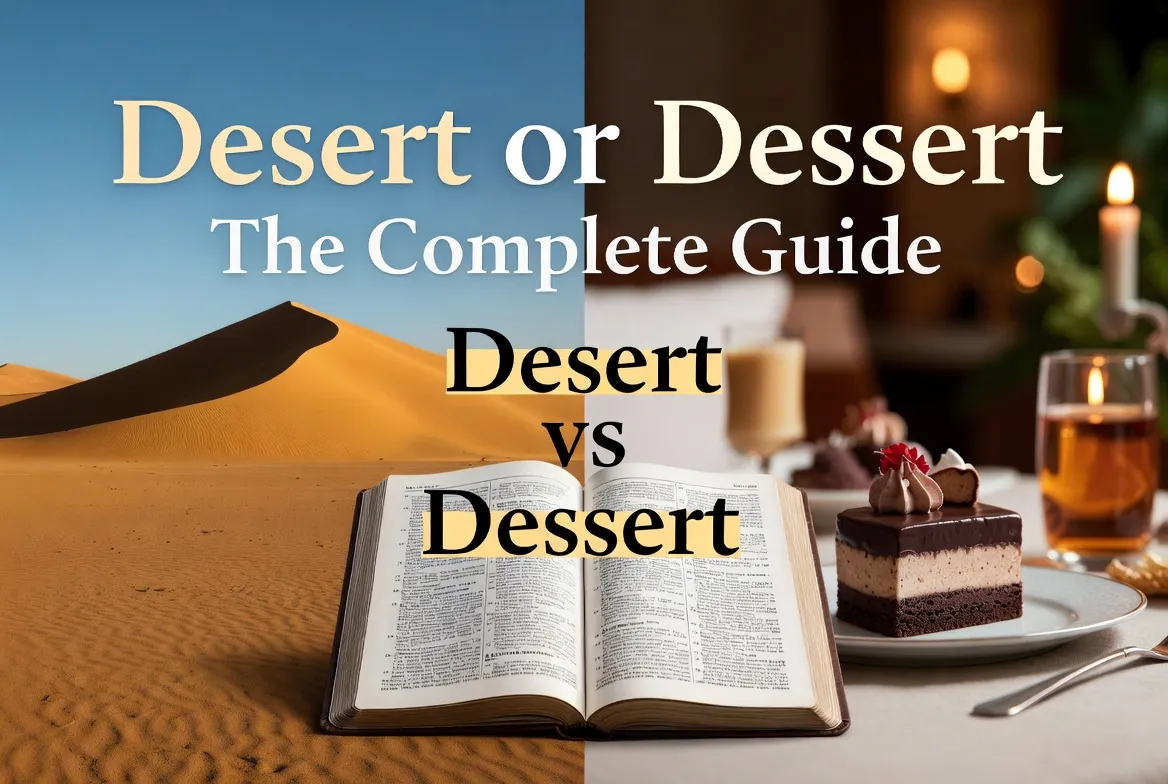
Quick Answer: Desert means a dry, sandy area of land or to abandon something, while dessert means a sweet food served after a meal. The difference is one letter, but the meanings are completely different.
Have you ever written a sentence and suddenly stopped because you were unsure whether to type desert or dessert? You are not alone. I have seen many English learners, writers, and even fluent speakers pause at this tiny spelling difference.
I still remember correcting a student’s writing where they described a delicious chocolate cake as a “desert.” The sentence was grammatically correct, but the meaning changed completely. Instead of imagining a sweet treat, the reader pictured a huge dry land full of sand.
This small spelling confusion happens because both words look almost identical and sound similar in some situations. However, they have different meanings, pronunciations, and uses.
In this guide, I will help you understand desert or dessert in the simplest way possible. You will learn their meanings, origins, pronunciation differences, common mistakes, and real-life examples. By the end, you will never confuse these two words again.
Desert or Dessert – Quick Answer
The words desert and dessert are different in meaning and usage.
- Desert can mean a dry place with little rainfall, or it can mean to leave someone or something behind.
- Dessert means a sweet dish eaten after a main meal.
Simple examples:
- The desert has very little water and few plants.
- My favorite dessert is chocolate ice cream.
- He decided not to desert his family during difficult times.
A simple memory trick:
Dessert has two “s” letters because you always want a second serving of sweets.
The Origin and Background of Desert and Dessert
Understanding where these words come from makes them easier to remember.
The History of Desert
The word desert comes from the Latin word desertum, which means “an abandoned place” or “a deserted area.”
Over time, the word developed two meanings:
- A dry, empty region.
- To leave or abandon someone or something.
For example:
- The Sahara Desert is one of the largest dry regions in the world.
- A soldier who leaves their position may be accused of deserting their duty.
The connection between these meanings is the idea of being left empty or alone.
The History of Dessert
The word dessert comes from the French word desservir, meaning “to clear the table.”
In the past, dessert was served after the main meal when the table was cleared. Over time, it became the word used for sweet foods enjoyed at the end of dinner.
Examples include:
- Cake
- Ice cream
- Pie
- Pudding
- Fruit dishes
The extra s in dessert became part of English spelling and helps separate it from desert.
Desert or Dessert Explained : Key Differences
Although these words look almost the same, their meanings are completely different.
| Term | Meaning | When to Use | Region/Context |
| Desert | A dry land area with little rainfall | Talking about geography or nature | Worldwide |
| Desert | To leave or abandon something | Talking about people, responsibilities, or places | Formal and everyday English |
| Dessert | A sweet food eaten after a meal | Talking about food | Restaurants, homes, cooking |
1. Desert as a Place
A desert is a region that receives very little rain.
Common examples:
- Sahara Desert
- Arabian Desert
- Mojave Desert
Example sentences:
- The camel can survive in the desert.
- Many plants in the desert store water.
2. Desert as an Action
The verb desert means to leave someone or something behind.
Examples:
- The man refused to desert his friends.
- The soldiers were punished for deserting their posts.
This meaning is often connected with loyalty and responsibility.
3. Dessert as Food
A dessert is usually a sweet dish served after a meal.
Examples:
- We had ice cream for dessert.
- The restaurant offers many delicious desserts.
Popular desserts include:
- Chocolate cake
- Cheesecake
- Cookies
- Brownies
- Ice cream
Which Version Should You Use?
Choosing the correct word depends on what you want to describe.
For Students and English Learners
Use dessert when talking about sweet food.
Example:
✅ I ate cake for dessert.
Not:
❌ I ate cake for desert.
Use desert when talking about land or abandonment.
Example:
✅ The camel walked through the desert.
For Writers and Professionals
Writers should carefully check the meaning because these words can completely change a sentence.
A travel article:
✅ The Sahara Desert attracts millions of visitors.
A food blog:
✅ This chocolate mousse is the perfect dessert.
A formal report:
✅ The employee should not desert their responsibilities.
For Global English Use
The safest approach is:
- Remember dessert = sweet food
- Remember desert = dry land or leave behind
This simple rule works in American English, British English, and other forms of English.
Common Mistakes with Desert or Dessert
Many people confuse these words because of their similar spelling.
Mistake 1: Using “desert” for food
❌ We ordered a delicious desert after dinner.
✅ We ordered a delicious dessert after dinner.
Why it happens:
People often forget the extra “s” in dessert.
Mistake 2: Using “dessert” for a dry place
❌ The Sahara Dessert is huge.
✅ The Sahara Desert is huge.
Why it happens:
Both words look almost identical.
Mistake 3: Forgetting pronunciation differences
The pronunciation changes depending on meaning.
- Desert (dry place): DEZ-ert
- Dessert (sweet food): dih-ZURT
Example:
“I live near the desert.”
“We had cake for dessert.”
Mistake 4: Confusing the verb desert
❌ He desserted his family.
✅ He deserted his family.
The verb always uses desert with one “s.”
Desert or Dessert in Real-World Examples
Professional Email
Correct usage:
Thank you for inviting me to dinner. I would love to try the chocolate dessert you recommended.
News Headline
Correct usage:
Scientists Discover New Species Living in the Desert
Here, desert refers to a dry environment.
Social Media Post
Correct usage:
This homemade strawberry cake is the best dessert I have ever made!
Formal Report
Correct usage:
The study examines how animals survive in extreme desert conditions.
Desert or Dessert : Data, Trends & Usage
The search phrase “desert or dessert” is popular among students, writers, and English learners because it is a common spelling confusion.
The search intent is mainly:
- Informational: People want to know the correct spelling.
- Educational: Students look for grammar explanations.
- Writing support: Writers want to avoid embarrassing mistakes.
This topic remains popular because English contains many confusing word pairs, especially words with similar spelling but different meanings.
Learning pairs like desert and dessert, affect and effect, and there and their improves writing accuracy.
Standalone Comparison Table: Desert vs Dessert
| Term/Variant | Meaning | Region/Context | Best Used When |
| Desert (noun) | A dry area with little rain | Geography, nature | Describing land |
| Desert (verb) | To abandon or leave | Personal, formal writing | Talking about leaving someone/something |
| Dessert (noun) | Sweet food after a meal | Food, restaurants | Talking about treats |
Frequently Asked Questions (FAQs)
Q: What does desert or dessert mean?
A: Desert means a dry area of land or to abandon something. Dessert means a sweet food eaten after a meal.
Q: How do you use desert and dessert correctly?
A: Use desert for dry places and leaving something behind. Use dessert for sweet foods like cake, ice cream, or pudding.
Q: Desert vs dessert : what is the difference?
A: The main difference is meaning. Desert has one “s” and refers to land or abandonment. Dessert has two “s” letters and refers to sweet food.
Q: Is dessert acceptable in formal writing?
A: Yes. Dessert is completely correct in formal writing when discussing food, menus, culture, or cooking.
Q: Which spelling is correct : desert or dessert?
A: Both spellings are correct, but they have different meanings. The correct choice depends on your sentence.
Q: Where does the word dessert come from?
A: Dessert comes from the French word desservir, meaning “to clear the table.” It became associated with food served after a meal.
Q: Can desert be used in professional writing?
A: Yes. Desert is commonly used in professional writing when discussing geography, environment, history, or abandonment.
Conclusion
The difference between desert or dessert may seem small, but the meaning changes completely. One word can describe a vast dry landscape, while the other can describe your favorite sweet treat after dinner.
Remember these three simple points:
- Desert = dry land or to leave behind.
- Dessert = sweet food after a meal.
- Dessert has two “s” letters because you want a second serving.
Once you understand the meaning and spelling pattern, this common English confusion becomes easy to solve.
Good writing is not only about big ideas. Small spelling choices also matter because they help readers understand your message clearly.
Now you know exactly how to use desert or dessert : go try it in your next piece of writing.
Leafs or Leaves: The Complete Guide to the Correct Plural

Ifrah Maqsood is an English author passionate about creating articles that inspire and engage users.
Their work explores imagination, emotion, and the human experience across diverse themes.
Through their writing, they aim to leave a lasting impact on audiences around the world.